
Enterprise vibe coding means using AI to create software quickly without giving up the controls businesses need to launch it safely.
Yes, you can now share or publish some vibe-coded software today. Codex Sites can deploy hosted web apps. Claude Artifacts can be published publicly on Free, Pro, and Max plans, while Team and Enterprise sharing is organization-restricted. Base44 and Replit can publish live apps. Microsoft Copilot can publish agents across multiple channels.
In one line: enterprise vibe coding is not just about generating software fast. It is about moving from prototype to production with governance, security, and publishing control still intact.
That gap matters more than most teams expect. The hard part is not only generating the first version. It is deciding how the software will be governed, secured, published, maintained, and trusted once real users depend on it.
What enterprise vibe coding means
Vibe coding on its own usually describes building software by prompt. You describe what you want in plain language, the AI creates a working version, and you refine it through conversation.
Enterprise vibe coding adds another layer: the software has to fit a real business environment.
That means the software cannot stop at a demo. It needs the security model, oversight, ownership, deployment options, and maintenance path that business software requires.
What the comparison really comes down to
Here is the more direct question buyers should ask as of July 8, 2026:
Think in terms of platform-level assurance vs customer-controlled implementation risk.
| Tool | Does this meet corporate infosec standards? | Does this meet corporate governance / IT governance standards? |
|---|---|---|
 |
No. Platform security exists, but no solution-level compliance guarantee is documented. | No. Production web deploys are supported, but not a governed enterprise rollout model. |
 |
No. Publishing is documented, but not solution-level infosec compliance guarantees. | No. Sharing and publishing exist, but not as an enterprise governance framework. |
 |
Maybe. Base44 documents SSO, access controls, security scans, and enterprise policies, but solution risk still depends on implementation choices. | Maybe. Governance depends on app visibility, permissions, integrations, and publishing setup rather than a guaranteed locked-down model. |
 |
Maybe. Strong controls exist, but compliance still depends on policies, connectors, and setup. | Maybe. Publishing and governance can be strong, but they remain configuration-dependent. |
 |
Maybe. Replit provides enterprise security and governance controls, but risk still varies based on deployments, dependencies, code changes, and app architecture. | Maybe. Governance can be stronger with enterprise controls, but teams can still change stack, dependencies, and deployment patterns in ways that affect risk. |
 |
Yes. Strong fit. Fliplet provides a more controlled delivery model, though final compliance still depends on customer requirements and configuration. | Yes. Built around governed creation, review, publishing, and rollout, with final governance still shaped by customer setup and requirements. |
But what businesses need after the first share link is still a different standard. That is where enterprise vibe coding starts to diverge from consumer AI app building.
Where sharing falls short
A share link or hosted preview solves only one part of the problem.
Business teams usually need more:
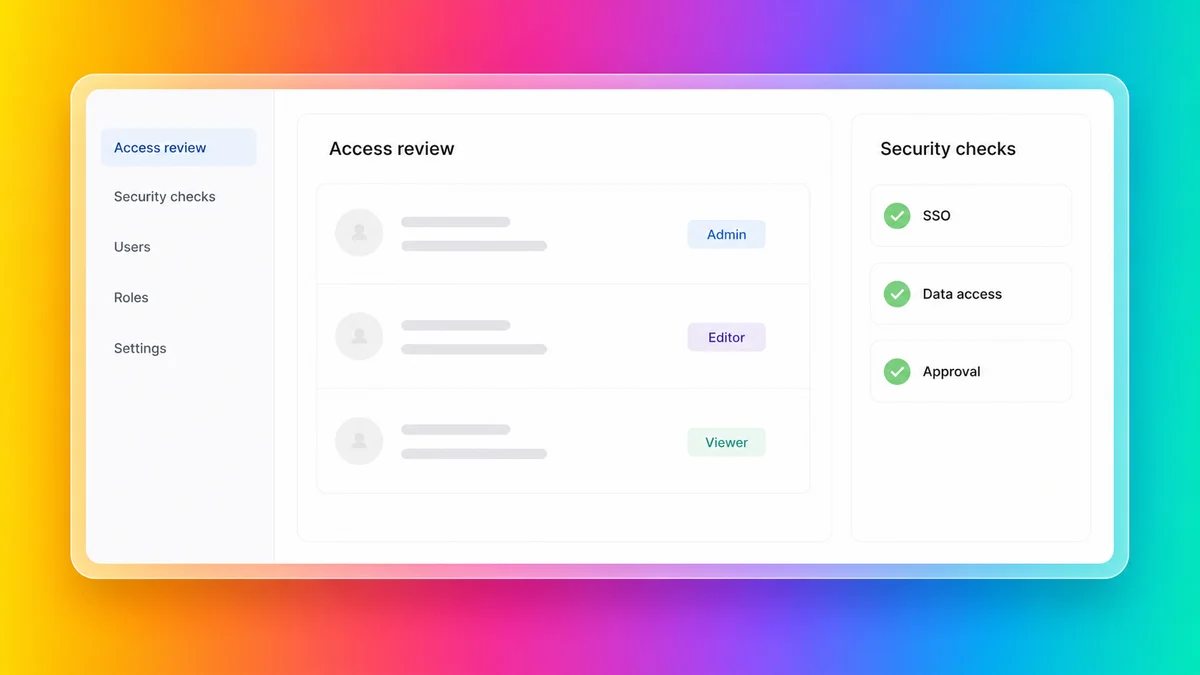
- Access control that matches the business. Not just "public" or "private," but the right users, roles, approvals, and sign-in model.
- A clear security model. Teams need confidence around data handling, identity, permissions, and release review before launch.
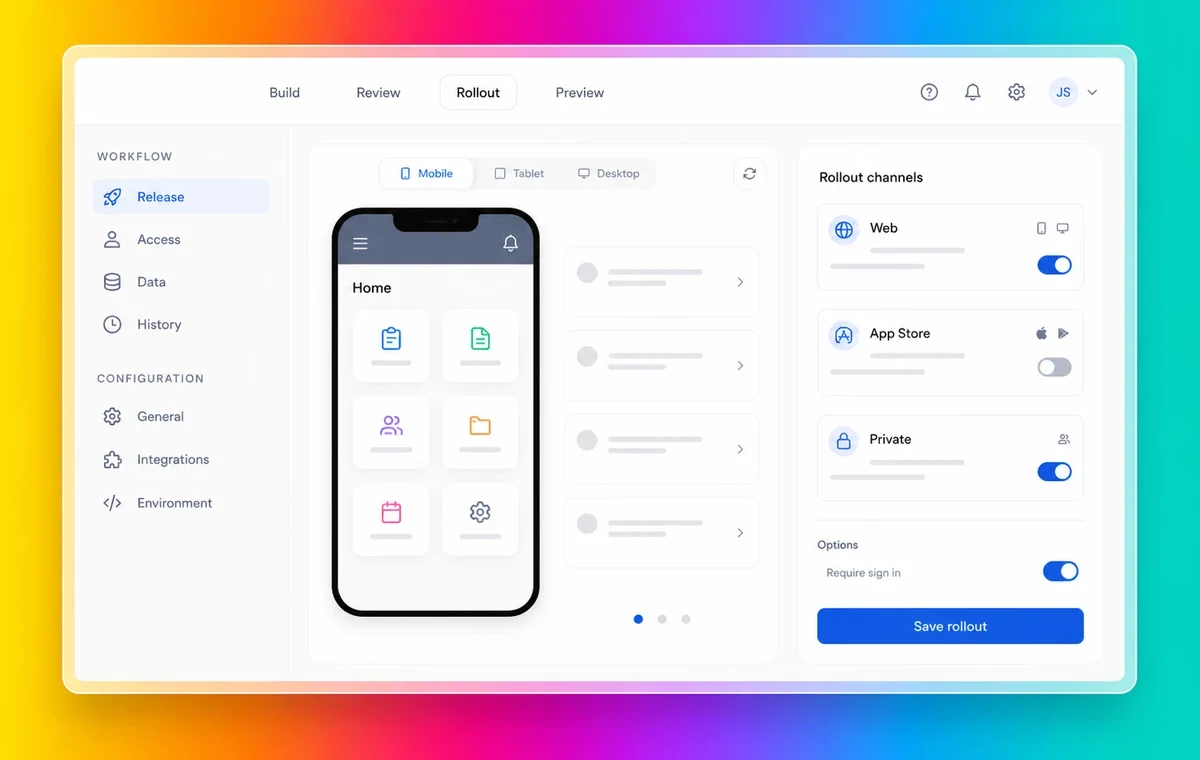
- Real rollout channels. A useful internal or customer-facing solution may need to live on the web, in public app stores, or in private enterprise distribution channels.
- Long-term ownership. If only the person who prompted the first version can safely change it, the solution is still fragile.
- Ongoing maintenance. Publishing is not the end. Apps need updates, oversight, fixes, and controlled improvements over time.
This is where many vibe-coded projects stall. They are easy to show, but harder to operationalize.
What changes when business data is involved
The stakes rise quickly once the solution is no longer a toy project.
If you are building employee onboarding software, a client portal, an internal approval workflow, or a field reporting tool, you are no longer only testing whether the AI can generate a usable interface. You are deciding:
- who can access the software and how they sign in
- what data the software stores and where that data lives
- how changes are reviewed before they reach users
- how the solution gets distributed to employees, customers, or partners
- who owns the solution after the original builder moves on
This is the point where many teams discover that "it works" and "it is ready for the business" are very different standards.
Why many vibe coding platform answers are "it depends"
The reason is not that these products have no security features. Several of them clearly do.
Many vibe coding platforms can help you host or share AI-built software. That does not mean they guarantee your specific solution will comply with your internal IT, security, and governance standards.
The problem is that platform-level assurance is not the same as customer-controlled implementation risk.
In the more flexible tools, users can often change or extend:
- the application architecture
- the frontend framework or runtime model
- backend functions and business logic
- external integrations and connectors
- authentication or access patterns
- deployment method and environment boundaries
In the more flexible platforms especially, users can often change the architecture, stack, integrations, and deployment model in ways that increase risk or move the solution outside approved guardrails.
That flexibility is helpful for experimentation. It also makes it much easier to create a solution that sits outside approved governance controls.
So the issue is usually not "Does the vendor have security documentation?"
The issue is:
- Does the vendor guarantee my specific solution will comply with corporate standards?
- Can makers change the architecture or stack in ways that increase risk?
For many vibe coding platforms, the honest answer is less a flat yes or no and more: it depends on how the platform is configured, what your team changes, and how tightly your business needs to govern the result.
What enterprise teams need
When you move from prototype to production, the buying criteria change.
- Governed creation: Business teams want speed, but IT still needs oversight.
- Secure data handling: Real software often touches employee, customer, operational, or regulated data.
- Identity and permissions: Access needs to follow your security model, not just a generic share setting.
- Version history and review: Teams need a safer way to manage changes and rollback decisions.
- Multi-channel publishing: Users may need web access, public app stores, or private distribution.
- Maintainable ownership: The software should stay editable and manageable beyond the original creator.
That is the difference between a useful prototype and software a business can actually run on.
Three common rollout scenarios
The easiest way to judge a vibe coding platform is to picture the real rollout, not the first prompt.
1. Internal employee software
If the software is for staff only, the questions usually become about SSO, permissions, governance, and controlled updates. A simple share link is rarely enough once the solution starts handling internal processes or sensitive information.
2. Client or partner access
If external users need access, the bar rises again. Teams need confidence around branding, authentication, data boundaries, and who can see what. A nice prototype is useful, but it does not replace a proper access model.
3. Mobile-first business workflows
If the software is meant for field teams, learners, event attendees, or distributed workforces, publishing channels matter much more. Some teams need a responsive web experience. Others need public app stores or private enterprise distribution. That choice should not be an afterthought.
Questions buyers should ask
If you are comparing platforms, these questions surface the difference quickly:
- Can we control who accesses the software, or are we mostly choosing between public and private links?
- Does the platform support the identity model our business already uses?
- Can the solution be published where our users actually are, including web, public app stores, and private distribution if needed?
- What happens when we need to update the solution after launch?
- Can someone else safely maintain the solution, or does knowledge stay trapped with the original builder?
- What security, compliance, and review controls are available before something goes live?
Why Fliplet fits
Fliplet is built for teams that want the speed of vibe coding inside a controlled delivery environment.
You describe the software you need in plain language. Fliplet helps generate the first version, refine it quickly, and move it toward production. The difference is that the workflow is built around business delivery, not just first-draft generation.
With Fliplet, teams can:
- Create with AI and keep IT involved. Business teams move faster, while governance, IT oversight, and rollout decisions stay visible.
- Work inside a stronger control model. Fliplet supports security review, solution access management, version history, rollback, and data access controls.
- Support stricter security and governance requirements. Fliplet's published security materials cover encryption, SSO, ISO 27001:2022 certification, and a GDPR-aware operating model.
- Publish where users actually are. Teams can publish to the web, Apple App Store, Google Play, and private enterprise distribution channels.
- Keep software maintainable over time. Teams can move from prototype through publishing and ongoing improvement in one workflow, while Fliplet handles platform upkeep and over-the-air updates.
That makes Fliplet a stronger fit when the goal is not just "Can we build this?" but "Can we run this safely?" Final compliance still depends on customer requirements and configuration, but the default delivery model is more controlled from the start.
The real decision
The question is no longer whether AI can help you create software; it can. The real question is what happens after that first working version appears.
If your team needs enterprise vibe coding rather than prototype-only vibe coding, Fliplet gives you a more complete answer than a share link alone. It helps teams move from AI-generated first draft to governed publishing across web, public app stores, and private distribution.
Talk to us to see how your team can move from prompt to secure, published software with governance, oversight, and maintenance built in.

Lisa Broom is the Head of Marketing at Fliplet, where she helps enterprise teams turn complex workflows into secure, user-friendly digital experiences.


Ready to see Fliplet live?
Build the software you actually need.
Book a demo to walk through your workflow goals, governance requirements, integration needs, and rollout model.