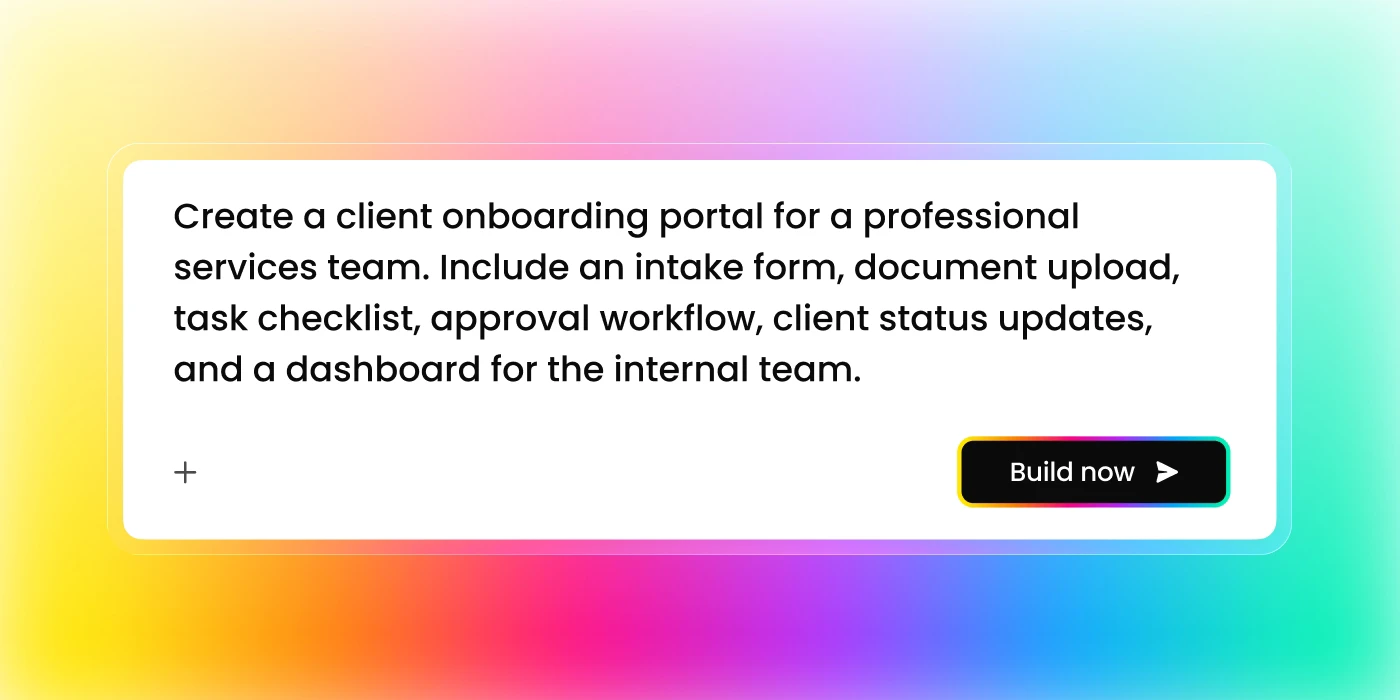
Vibe coding is a way of building software by describing what you want in plain language and letting an AI tool generate the working result. Instead of writing every line by hand, you describe the outcome — "build me a field-inspection app that captures reports and routes issues to the right manager" — and the AI produces something you can run, test, and refine through conversation.
In one line: vibe coding is building software by conversation rather than by hand.
What does vibe coding mean?
The term vibe coding was coined in February 2025 by AI researcher Andrej Karpathy, who described "giving in to the vibes" — letting the AI write the code while you guide it by describing what you want. The "vibe" is the point: you work at the level of intent and feel, not syntax. The name stuck because it captured how different this is from traditional programming — you're directing an outcome, not authoring every line.
How vibe coding actually works
The workflow is a loop, not a one-shot command:
- Describe the outcome. You explain what you want in business terms — the screens, the data, the actions, who uses it.
- The AI builds a working version. A functioning draft appears in seconds, usually with a live preview.
- You test it like a user. Click through it. Try the common path and the awkward edge cases.
- You refine by talking. "Disable submit until every field is filled." "Add a status column." The AI rewrites and you re-test.
- You repeat until it does the job — then you publish it.
The skill is no longer typing code. It's describing intent clearly, spotting when something's off, and being specific about what "right" looks like. That's much closer to how an operations lead or product manager already thinks than to traditional programming.
Who is vibe coding for?
It has quickly become a tool for people who were never going to learn to code:
- Operations and IT teams building internal software — request trackers, audit checklists, approval workflows — without waiting in a development backlog.
- Product managers turning ideas into working software to align stakeholders fast.
- HR and People teams standing up onboarding portals, policy hubs, and employee tools.
- Customer-facing teams launching client portals, event apps, and field-service tools on their own timeline.
- Founders and small teams shipping real software without a full engineering function.
The common thread: someone who understands the business problem deeply but doesn't have ready access to developer time. Vibe coding closes that gap — which is why it's spreading through business teams, not just engineering ones.
Vibe coding examples
To make it concrete, here's the kind of software teams build by prompt:
| Team | What they build | Why it works |
|---|---|---|
| Field Operations | An inspection app that captures reports and routes issues | Replaces a spreadsheet-and-email chain |
| HR | An onboarding portal with status tracking per new hire | Structured, visible, no chasing |
| Customer Success | A branded client portal for documents and updates | Built in days, not a dev quarter |
| Events | A session sign-up and feedback app on web and/or mobile | Ships on the team's own timeline |
| Sales | An interactive ROI calculator for prospects | Built and changed in an afternoon |
Each of these used to need a developer, a ticket, and a wait. Vibe coding compresses that to a conversation.
The benefits: why business teams are adopting it
- Speed. A working draft in minutes instead of a sprint.
- Lower barrier. The person with the idea builds it, so nothing gets lost translating a spec to a developer.
- Cheaper experimentation. Test ten ideas for the cost of building one the old way.
- Clearer requirements. A working prototype communicates intent far better than a written brief — even when engineering takes over later.
These gains are real, and they're why vibe coding isn't a passing trend. But there's a catch that decides whether your vibe-coded software is a throwaway demo or a tool your business can actually run on.
Vibe coding tools and platforms: what to look for
Vibe coding tools fall into two camps, and the difference decides whether what you build is a throwaway demo or software your business can run on. Most early tools were built for hobby projects; a smaller set are built for business. Here's how to tell them apart:
- It can look finished before it is. Generated software demos beautifully and can still mishandle edge cases or break when requirements change.
- Maintainability matters. If only the person who "vibed" it understands it, you've created a dependency, not a solution.
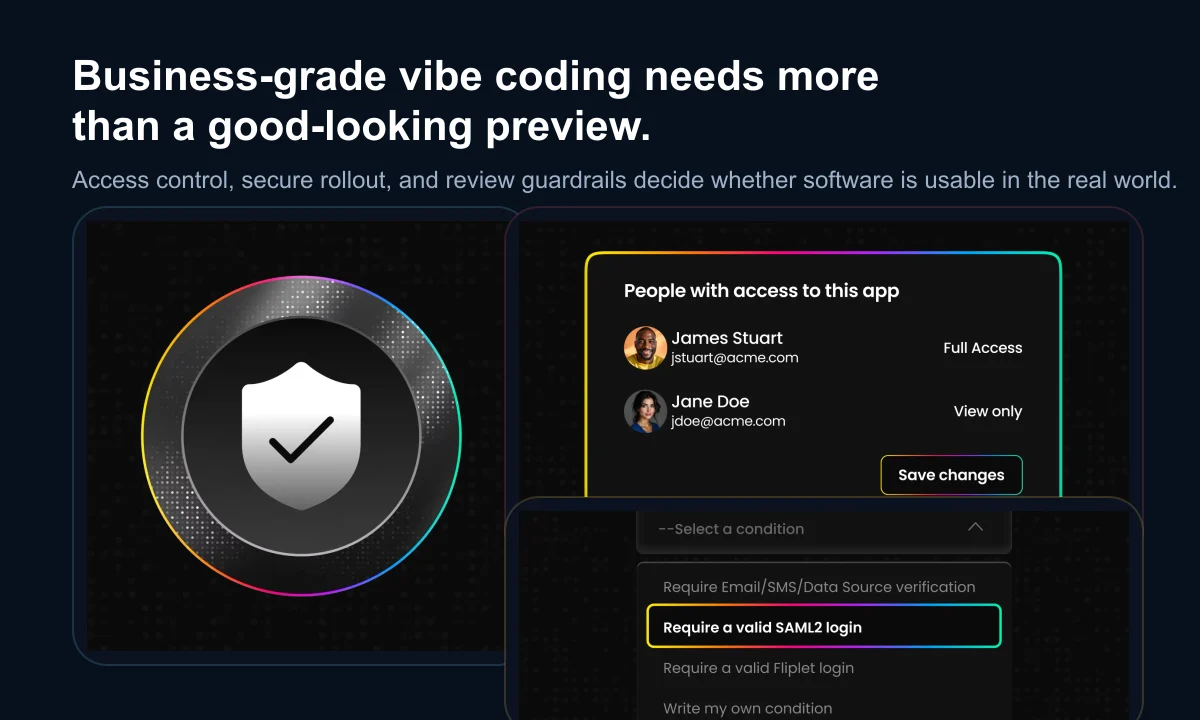
- Security and compliance can't be an afterthought. Business software handling customer or employee data needs encryption, access controls, and an audit trail by default — not if someone remembers to ask.
- Data governance has to be clear. Where does the data live? Who can see it? Does it stay inside your compliance boundary?
- It has to reach real users. A prototype trapped in a preview window isn't software. Business tools need to be properly published — on the web and in the app stores where employees and customers actually are.
None of this means vibe coding is risky. It means the tool you vibe code with has to be built for business. Here's what to demand:
| What business software needs | Consumer vibe coding tools | Business-grade vibe coding |
|---|---|---|
| Speed from prompt to working software | Yes | Yes |
| Secure handling of business data | Often not | Built in |
| Access controls & audit trail | Rarely | By default |
| Data kept inside your compliance boundary | Unclear | Guaranteed |
| Maintainable by your whole team | Usually one author | Anyone with access |
| Native publishing to web and/or app stores | No | Yes |
The point isn't to vibe code less. It's to vibe code on a platform that takes you all the way from prompt to production.
Compare AI software builders
If you are comparing specific AI software builders, start with the type of ownership you want after launch. These comparisons cover common options:
- Base44 vs Fliplet AI software builder comparison
- Lovable vs Fliplet AI software builder comparison
- Bolt vs Fliplet prompt-to-code software comparison
- Replit vs Fliplet AI coding workspace comparison
- Copilot Studio vs Fliplet AI agent vs business software comparison
- Betty Blocks vs Fliplet software platform comparison
Fliplet: vibe coding built for business software
This is exactly what Fliplet's new AI-driven platform was built for.
You describe the business software you need in a prompt — and Fliplet builds it for web and/or mobile. The difference is everything that happens around the prompt:
- Safe for business data by design. Your data stays inside a secure, governed boundary — not on some tool's servers outside your compliance scope.
- Enterprise-grade security built in. Access controls, encryption, and the security business software actually requires, from the first version.
- Native publishing to the app stores. Fliplet doesn't leave your software stuck in a preview. It publishes natively to the Apple App Store and Google Play, plus the web — so your teams and customers can actually use it.
- Maintainable by your team. Built so anyone with access can update it, not just the person who first described it.
In other words, Fliplet gives you the speed and ease that make vibe coding so compelling — and the security, governance, and reach that turn a prototype into business software you can run on.
Start for free to see how your team can go from prompt to secure, published web and/or mobile software with Fliplet.

Lisa Broom is the Head of Marketing at Fliplet, where she helps enterprise teams turn complex workflows into secure, user-friendly digital experiences.
Ready to build with Fliplet?
Start building software with AI.
Describe your use case and start building governed web and/or mobile software with Fliplet.