Event recap
Vibe Coding in Law Firms:How to InnovateWithout Losing Control


At ILTACON 2026, Fliplet CEO Ian Broom spoke with James Grice, Head of Innovation & AI at Lawfront, and Stephanie Lopez, Senior Manager of UI/UX Development at Willkie Farr & Gallagher, about how law firms can let more people create software with AI without losing control of security, data, quality, or publishing.
The conversation brought together two different perspectives. Lawfront is building a group-wide innovation capability across a growing collection of regional law firm brands and inherited technology environments. Willkie already has an established development team and is exploring how AI-assisted creation can help it support more people, respond to urgent needs, and protect specialist time.
In this article

From left to right, Stephanie Lopez of Willkie Farr & Gallagher, Ian Broom of Fliplet, and James Grice of Lawfront at their ILTACON 2026 session, “Vibe Coding in Law Firms: How to Innovate Without Losing Control.”
The following is a detailed transcript of the session
Before the customer interviews, Ian described a recent encounter that had changed how he thought about who might use Fliplet. It began with a law firm associate, an 80-page legal document, and a calculation the lawyers could not safely delegate to an opaque spreadsheet.
Ian's opening story
"Recently I was at a networking event, an entrepreneurial networking event in the UK, and I bumped into an associate from a large UK-based law firm. And usually when I bump into associates, I'll be honest, they don't like me, because I'm not raising money fast enough, I'm not doing down rounds, I'm not trying to exit at the moment. There's no money in this conversation for me; why would I continue it? Which I get, I understand. So I'm always very polite. I'm like, 'Yep, this is what we do. By the way, we work with a lot of law firms.'
"And this one associate surprised me. He said, 'Really? We need what you do.' And I said, 'Are you sure? I don't usually hear that from lawyers.' Usually what I hear from lawyers is, 'Mm-hmm, yep. So you work with the IT team? Okay, great,' and they want to go off and find the next person they can talk to about possibly doing some work with.
"Anyway, so we exchanged details, and a couple of weeks later we got on a call. To my surprise, he brought a partner with him. That also generally doesn't happen, particularly on the first call. So I was like, 'Ooh, this guy must be serious. He must really be excited about what we're able to help him with.'
"And I said, 'Okay, so what interested you about Fliplet?' And he said, 'Well, we deal with anti-dilution clauses when organizations are going through some form of shareholder changes and things like this.' You can tell that I'm not a lawyer, right? I didn't understand what they were telling me.
"And he said, 'It's really complicated. It can get very complicated. The maths can be very complicated, and we don't have a solution to this.' And I said, 'Well, hang on, don't you have other AI tools?' And they said, 'Yeah, we've got [Microsoft] Copilot, but that's not necessarily great at doing this.' I said, 'Okay.' And they said, 'We've also got Harvey, and that can do it, but we have to keep kind of feeding the information in. It doesn't give us the tool that enables us to do this calculation efficiently.'
"And I said, 'Well, can't it produce a document template for you or something that would help?' They said, 'Yeah, we tried that as well. We asked it to produce a spreadsheet. But the problem with the spreadsheet is we have to understand the spreadsheet. We can't just blindly trust what the spreadsheet is doing when it's running calculations for our clients, and we couldn't understand the spreadsheet.'
"I said, 'So what would you like to do today?' And they said, 'Well, we've got this document.' It turns out it was an 80-page document. It was a template that they used and then customized for their customers, and it had an anti-dilution clause in it. And I said, 'Well, what does that clause include?' And they showed me, and it included loads of formulas that had been inserted using the formula feature inside Word.
"And I got a bit nervous because, I mean, I think our software can deal with Word files, but I'm not sure it can deal with formulas. So I didn't know what was going to happen.
"And so the associate created an account on Fliplet. You'll see Fliplet in a second, by the way. The associate created an account on Fliplet, and I said, 'Well, just attach the file and just try to be a bit specific, because it's a big file. You don't want AI misunderstanding what it's doing.'
"And so he said, 'Go and get section 10. I want an anti-dilution calculator.' And he clicked go, and Fliplet asked him some questions, and then it produced an anti-dilution calculator.
"Now, as you know, I don't know anything about anti-dilution calculators, so I wasn't able to sit there and say, 'Is this good?' I just had to say, 'Did it do a good job?' And the associate and the partner were just silent, looking at each other, going, 'This is amazing.' And I was like, 'Is it? It looks like a calculator.' They were like, 'This is so great. We understand what it's done. Look.' And they started explaining it to me. And then they immediately started thinking about other things they could add to it, et cetera.
"And I'll be honest, Fliplet as a company has been around for 17 years. We've had the last version of Fliplet in market for 10 years. Historically, we did not promote Fliplet to attorneys or lawyers. We considered it too complicated. It was drag and drop. It was no code. And now, with this new version that's powered by AI, I'm starting to rethink all of that. I'm starting to think, is this actually now a tool that should be used more by attorneys, and maybe not just historically by marketing and IT?
"So that's the story of empowerment that I wanted to kick off with. Hopefully that gives you a bit of a sense of what the tool is capable of doing."
The story illustrates an important distinction. The lawyers did not simply want AI to generate an answer. They needed a reusable tool whose workings they could understand well enough to trust when performing calculations for clients. The fast prototype mattered because it turned the relevant clause and formulas into something the lawyers could inspect, explain, and improve.
Before Ian interviewed James and Stephanie on stage, he kicked off a live demo that he showed in three parts during the presentation.
Read the three-part demo summary.
James: a governed route for legal innovation
Ian: Can you tell me a bit about your role and what your current priorities are?
James: I am Head of Innovation & AI at Lawfront. Lawfront is not a technology vendor; it is a legal services business in the UK. We are private equity backed and, at the time of the session, had acquired 16 law firms over four years, with a seventeenth and eighteenth expected soon. We operate seven regional law firm brands around the UK.
You will not see Lawfront on the high street. We acquire strong brands in regions outside London, continue to operate those brands, and provide them with business services including HR, finance, IT, and technology.
Acquiring firms at that speed brings a significant challenge: every firm arrives with its own legacy technology debt. That includes practice-management, document-management, and case-management systems; pockets of legal technology acquired along the way; and different subscriptions to services such as Lexis and Practical Law. We have to bring all of that into the group, manage it, support it, and ultimately move the firms towards the best-in-breed future platform we want to provide.
It is a challenging, fast-moving, and dynamic environment. We can sometimes move more quickly than a traditional law firm because we are not beholden to the usual partner model. We can take risks more openly, get a single point of decision from our executive team, and drive forward more quickly.
I had been with Lawfront for around 18 months at the time of the session. Before that, I spent just short of a decade at Eversheds Sutherland in a variety of technology and transformation roles.
Ian: What were your thoughts when you first saw this new version of Fliplet, from both a personal and a professional perspective?
James: Ian and I go back about ten years. We had worked together with the earlier Fliplet and, rightly or wrongly, I had bracketed it in my mind as a low-code mobile app builder. When I joined Lawfront, I did not have an immediate use case, although Ian and I continued talking and meeting at events.
A few months before the session, Ian asked whether I would give up an hour to look at something he was excited about. I like shiny new technology and Ian is a friend, so I said yes.
He gave me what he called a reverse demo. I joined the call without a brief. Ian gave me a link to the new version of Fliplet, got me logged in, and asked me to start using it without much guidance. He watched, laughed at some of the questions I asked, refused to answer them, and told me to try things in the system.
The timing was useful. About a month earlier, my team and I had started exploring vibe coding: what products were available, which platforms we might use, what technical limitations they had, and how much support we would need from other IT teams to use and deploy what we created.
The first thing I built was a very simple event app because that was all that came to mind. It came together quickly and looked good, but I did not have a strong use case for it. Then I had two fairly rapid light-bulb moments.
The first was a smaller, immediate need. Across our seven firms, we wanted a simple way to share and manage a more sophisticated version of a prompt library. We call it our recipe-card platform. We had nothing in-house that worked across all seven firms, and I suddenly thought Fliplet could help. I could build it, manage it, control it, and deploy it without having to add another task to the IT team's workload.
The second came from a conversation with one of our more technically confident and AI-enabled lawyers. He had spent an evening building two or three Claude artifacts on his personal computer and asked how he could deploy them inside the business. My response was: "You don't." We were not ready for that, and we were not set up to deploy independently created Claude artifacts into the firm without much more thought and preparation.
As I continued using Fliplet, I realized I might be looking at a platform that could solve some of those issues. It could give lawyers a safe space to build what I would call micro apps: small, containerized tools that solve focused, task-based problems. I could administer and manage the environment, control who was using it, what they were building, where and how they were building it, and apply the security guardrails Ian had described.
That was particularly important because our IT resources were stretched. I could control and deploy these small solutions without needing additional IT input every time because the surrounding capability was already in the platform.
I went into the session as a favor to a friend and expected to see something interesting. I came away with one relatively small problem potentially solved and a much bigger opportunity for the future. I am a strong proponent of design thinking, hackathons, and ideation sessions. I could also see an opportunity for rapid prototyping: helping lawyers move from an idea to a working prototype that could become a deployable solution in a short space of time.
Ian: What key aspects will you need to focus on to start rolling this out?
James: First, we need confidence in the platform and to launch our initial solution, which was close at the time of the session. Then we need to socialize the capability across the business.
Neither I nor my team are lawyers. We are not legal experts and are not deeply embedded in every specific legal process. We need our lawyers to understand our capabilities at least at a surface level so that they can bring us the problems they are trying to solve.
We have a few pockets of that already, including the lawyer who built the Claude artifacts. But many users do not yet understand the potential of the technology stack and AI tools we already have, let alone what vibe coding could add. There will therefore be a substantial element of education and awareness.
Some ideas will come through the tasks, problems, and questions people already bring to the innovation team, where we may naturally choose Fliplet as the solution. We also need to experiment. We have discussed reporting dashboards, integrations, APIs into other platforms, and using Fliplet to help my team demonstrate return on investment.
There were many possible use cases bubbling around in my head. I did not yet know which would become priority number one, but I was excited to get started.
Ian: What software-development skills do the people using Fliplet have?
James: My team has no developer skills and no coding capability. They are legal engineers or legal technologists. They are highly creative, understand vibe coding as a concept, and have become very good at prompting, but they have no development background.
That is part of the appeal. The skills I need are people who can talk to lawyers, engage them, understand a legal process, and translate that into what IT needs. I had not needed developers in the team before. Fliplet allows us to harness the team's existing skills without recruiting a dedicated developer skill set for these projects.
The platform also provides the wraparound capability for areas where I might otherwise have needed support from information-security specialists, technical IT colleagues, or architects. It lets an already well-embedded team that understands the business's problems get creative inside a managed environment.
Stephanie: more ways for a development team to say yes
Ian: What do you do, and what are your current priorities at Willkie?
Stephanie: The simplest answer is that I manage development at Willkie Farr & Gallagher, although the role entails many different things.
It is difficult to summarize our priorities because, as large as Willkie is, we also try to be small and distinctive in how we work. The firm has major priorities around growth, new offices, and new industries and areas of business. At a smaller level, we also need to make sure the individual teams inside the firm are well supported.
My team may be enthusiastic about AI, but other teams are not in the same place. Part of the priority is working out how to bring those people along, ease their pain points, and make their valuable billable hours matter.
Ian: What did you think when you first saw this version of Fliplet?
Stephanie: I was blown away. We have had the privilege of working with Fliplet for years. We still use the original version for some work, and we love the newer version.
The first thing that came to mind was that, although I have developers, I did not have to use them for every build. That matters when the familiar last-minute call arrives: "I need something by tomorrow. Can I have it?" Normally I would be asking which developer had to work until midnight, which one would not hate me, and how we were going to get the work done.
With V3, I do not need that in the same way. Either I do not need a developer for the task, or the developer does not have to work until midnight writing every part manually. I can go into the platform, have a conversation, and explain the need.
The first thing we built took about half an hour and went live. I remember thinking, "Ooh, I get to have dinner with my family tonight." It was great.
For me, the best part is having options and choices. People say you should use the right tool for the right job. I can choose a developer and the earlier platform for a larger project, or choose V3 and open the work to people who are not developers.
Our marketing team, for example, runs many events and regularly asks for surveys. I gave one of them access to V3 and said, "I'm going to show you how to build a survey, and you can do it by yourself all the time." They now love it, and that is one less thing on my to-do list.
That does not mean I disappear. I am there to support them and answer questions. Sometimes AI produces something they like 95%, but they need help with the remaining 5% adjustment. That is easy to support. The platform gives us choices and helps us grow in ways that would not have been as easy or as quick before.
Ian: How do you expect Willkie to use this? Will you bring over existing projects and tasks, or will it open new opportunities?
Stephanie: Both. I can see us bringing some of the work we already do into V3.
One of the larger experiences we build every year is for the firm's partner retreat. It has grown over time and acquired many bells and whistles, all of which have traditionally been hard coded. We have the resources to do that, but it takes time. As a manager, I have to allocate people and plan timelines, and there is always scope creep.
If we can do more of the work in V3, we can save time and leave room in the project schedule for the inevitable late request to add something before the deadline.
The other opportunity is work that we previously could not accept. Time is finite and I cannot say yes to every project. There are many competing senior stakeholders and limited delivery capacity, so some requests have to wait in line even when they address important pain points for a team or individual. With V3, I can say yes to more people and help resolve more of those issues.
Ian: How do you think about the risk of a tool like this, and who do you want to give access to?
Stephanie: Fliplet lets us customize the setup to suit Willkie. My team owns Fliplet Studio and the platform, and I allocate licenses and permissions as I think appropriate.
Someone in marketing might be allowed to build surveys, for example, but they are not allowed to publish them. They still have to come through me so that we can check the result before it goes live.
The appropriate permissions differ from person to person. I may give one person broader access. With someone else, I may simply invite them into Fliplet Studio and say, "I really want you to take a look. I think you're going to like this."
People sometimes respond that they know nothing about coding. But if they have a strong idea, that is enough to begin. They do not need to do what I do; I am there to support the technical part. Some of the greatest value comes from people who do not do my job but can now meet us in the middle. Fliplet creates that bridge.
That is particularly valuable for partners who want to do more but do not know how to get the idea in their head onto paper or out into the world. We can help them make that transition and translate the idea into something usable.
Ian: Are there projects you would keep within your team rather than letting partners explore themselves? Is there a line for you?
Stephanie: My instinctive answer is no. If someone has an idea, let us try it. Why not?
That does not mean there are no guardrails. I am not trying to "yuck their yum," but I am trying to keep everyone safe and, ultimately, give people what they really want rather than simply what they think they want. Those can be two different things.
The conversation yesterday was around sort of just, they wanted a simple, 'Hey, can we just have like a...' They do a manual sign-up sheet for a lot of their sessions. 'Can we just have some way to do this electronically?' Yeah, we can.
And, okay, great: create a QR code, they can scan it. We all have firm devices, so the minute they scan it, it logs in, gets user data, all they have to do is press a button and say they were in the session. They no longer have to sit there with their name and their email and their info and filling things out. Great, love that.
And so then, for me, it was, 'I love that idea, but we have to take it a step further,' right? Because now you're going to have a table with all that data. What are you going to do? 'I'm just going to download it and delete the table.' Oh, God, no. You don't really want to do that.
You want to hold on to that data. You want to be able to pivot on that data. You want to be able to go back and say, 'This person has attended my last three sessions.' You want to do things with that. And that difference. So that's what I mean by guardrails, right?
Somebody might have a beautiful idea, but how do you help them maybe expand that and make it more, and show them those things they don't even know they should be thinking about?
Ian: Are you able to make those suggestions because you have seen how easy the technology makes them, or because the people you work with are still on their AI journey and have not yet learned to push its limits?
Stephanie: It is not that people are already pushing the limits. Many partners and other people at the firm are still scared of AI. Sometimes getting them to use it means sitting down with them, holding their hand, and saying, "I promise you, it is not what you think it is. It will be safe."
There are two parts to why I can make the suggestions. I had been at Willkie for 14 years at the time of the session. It has taken years of hard work to understand the partners and how they operate. In development, I have to get inside how people work so that I can give them the right suggestion.
That knowledge makes the suggestions easier, and the relationships create enough trust for someone to say, "Okay, I trust you. I get it. Let's try it your way." That is how I help people get past the reaction that AI is scary or not right for them.
The immediate challenge is getting them to take the first step. V3 helps because they do not need to code and it does not look like a coding platform. It looks more like the conversational AI tools they may already use. They can dictate, "This is what I'm thinking," and see the platform turn that into something they can discuss.
Ironically, the people I worry about more are sometimes technical colleagues who think they already know what they are doing. A partner taking a guided first step in V3 can be less concerning than an overconfident technical user operating without the right review.
Ian: Is there anything else I did not ask that I should have asked?
Stephanie: The point I most wanted to add was what happens beyond the conversational build. For people who manage and plan projects, use vibe coding, and build software for their organizations, Fliplet handles a tremendous amount of technical debt and back-end work. I describe that as helping us "cut the line."
If I build something from scratch with my team, we have to decide whether it will be hosted internally or externally, manage certificates, choose a codebase, plan how to maintain it, and allocate back-end, front-end, and quality-assurance resources.
Fliplet handles much of that surrounding work. During the years we have used the platform, its data capabilities have developed from flat data tables to dynamic structures with joins and more useful ways to analyze data. Fliplet hosts the software, handles certificates, and supports custom domains, so I do not have to recreate all of the back-end setup separately.
The simplicity of V3 is valuable, but what happens after the build is just as important. You have created something; how does it go live? Usually that extra work would happen outside the builder. With Fliplet, once the solution has been reviewed and is ready, publishing can be as simple as pressing a button.
Ian's live demo in three parts
Part 1: Brief and build
Ian used Fliplet's built-in dictation to request an ISO 27001 and SOC 2 compliance-tracking tool. His deliberately high-level brief asked for a way to see the status of compliance tasks and produce information for an auditor. Fliplet asked about branding, created a non-technical plan covering users and core features, and began building after Ian approved it. He left the build running while he spoke with James.
Part 2: Review and refine
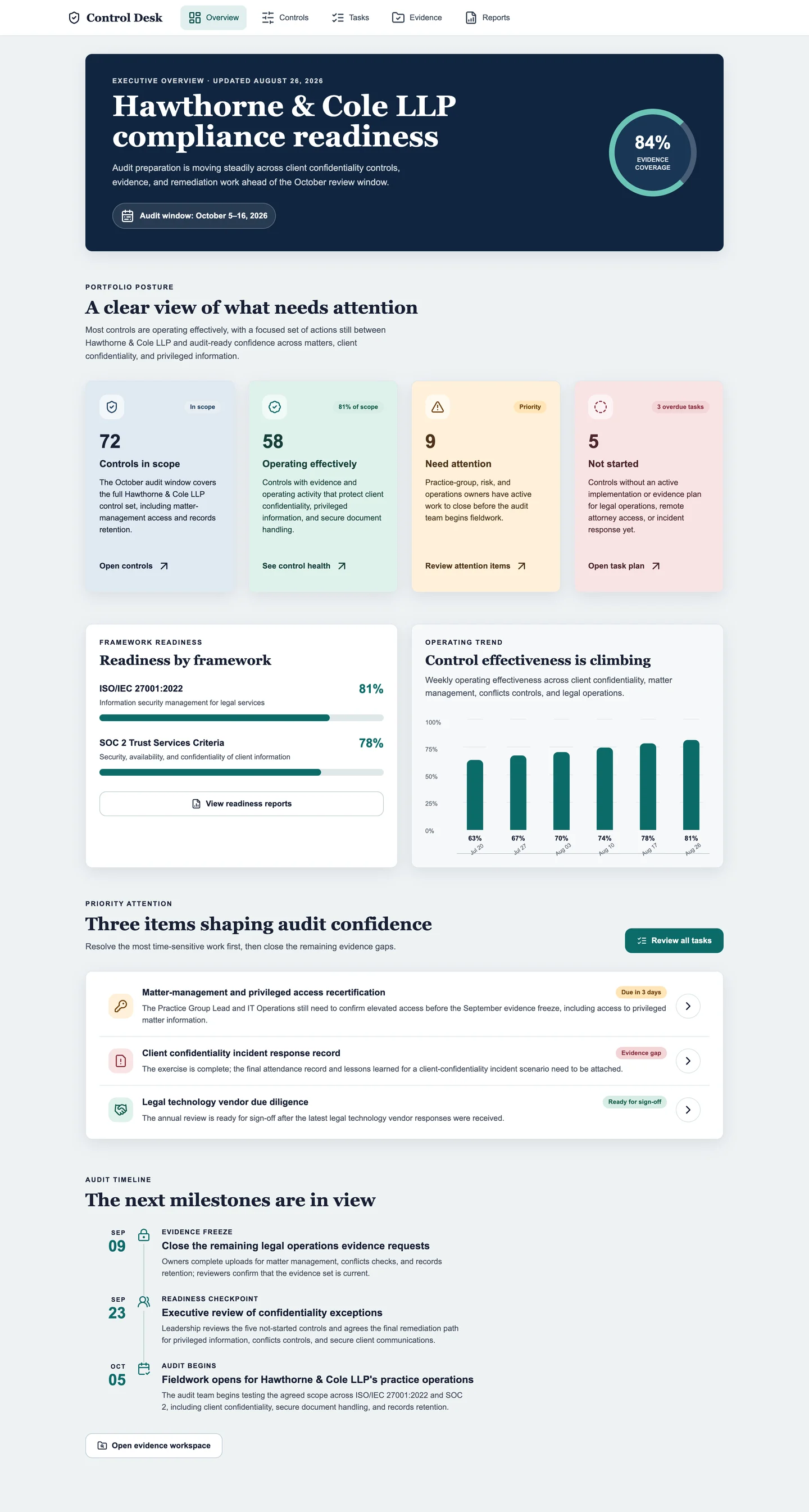
About seven minutes later, Ian returned to a first-phase prototype rather than finished production software. It included readiness metrics and charts, a timeline, ISO 27001 and SOC 2 controls, a Kanban-style task view, an evidence library, and reports. Ian used it to show how a short brief can become something stakeholders can inspect and improve. He then corrected an intentional omission by telling Fliplet that the organization was a law firm, prompting another iteration while he spoke with Stephanie.
Part 3: Publish, inspect and test
The updated version added law-firm considerations including client confidentiality, privileged information, matter access, conflicts, and records. Ian then showed the routes from prototype to delivery: publishing to the web, Fliplet Hub, or app stores; using a temporary or custom domain; and sharing the result by QR code. He also opened the code editor to show that developers could inspect and change the code manually, then explained how AI could generate a test plan and run automated browser-based tests. Together, the three parts demonstrated briefing, prototyping, refinement, technical inspection, testing, and publishing.
Audience Questions
Audience: How do you handle AI token limits, and how far can the tool be pushed before it struggles?
Ian: Nobody wants to hit token limits in the middle of a project. It is frustrating, especially when you are working to a deadline; it has happened to me with my own AI subscriptions. For a paying enterprise customer, we would agree an allocation of tokens. The system would warn you if you went beyond that allocation, but we would let you continue rather than cut you off in the middle of a large project.
There are other limits, though. You can get the AI bogged down and struggling to understand what you are doing, just as you can with other AI coding tools. It is about managing the AI and keeping it focused on the task you want it to do.
One option I did not show in the demo is clearing the conversation, which removes the historical conversation context so the AI can focus again on the current work. If a project is becoming unwieldy, you can also ask, "Do you think we should refactor any part of it?" The AI can then reorganize parts of the project to make it easier to keep working with.
How does token usage in Fliplet compare with using a general-purpose AI model directly?
Stephanie: Token use varies depending on how specific the request is and how much work is involved. My team uses several AI tools, and the difference I see is that Fliplet is a platform specifically built for creating software. It already provides a structure and guardrails for that work.
A general-purpose model can build software from scratch, but it does not begin with the same guardrails. You can spend many tokens explaining and recreating those boundaries. In Fliplet, the AI already knows you are building software, so you start further ahead. In my team's experience, that means using fewer tokens than we would if we worked only with a general-purpose model outside Fliplet.
Audience: Does Fliplet have memory so it does not have to redo work from previous conversations?
Ian: Yes. To Stephanie's point, it is quite efficient in how it uses its own tools and environment.
We are also working on a new feature, which I believe is in testing, that uses a Markdown file to track the status of the project. You can leave and come back, and the AI can read that file to get up to speed without necessarily having to read the entire project again. That becomes particularly useful as projects get large.
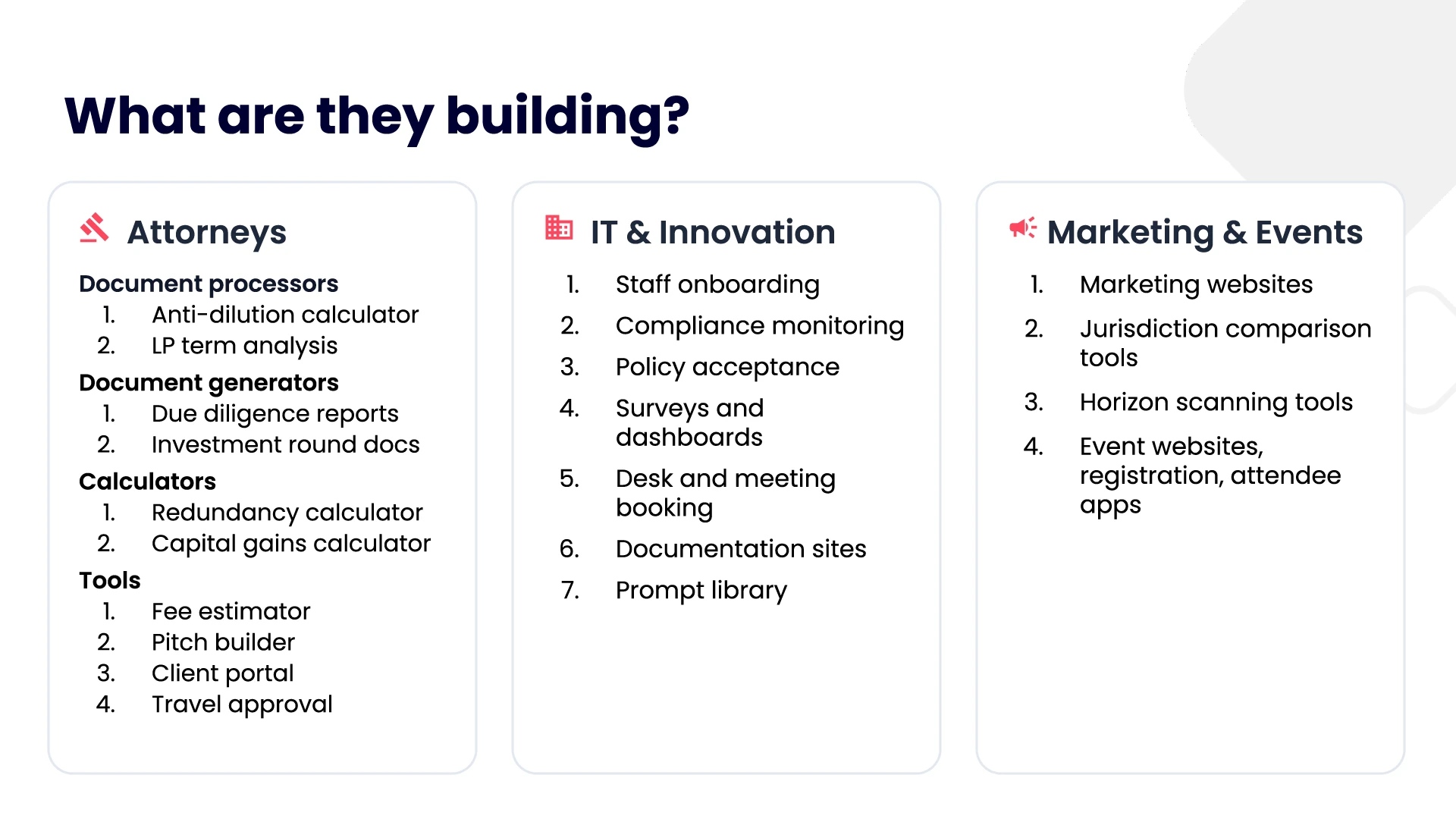
Examples from the session, grouped by team
Attorneys
- Document processors: anti-dilution calculator and LP term analysis.
- Document generators: due diligence reports and investment round documents.
- Calculators: redundancy calculator and capital gains calculator.
- Tools: fee estimator, pitch builder, client portal, and travel approval.
IT and innovation
- Staff onboarding, compliance monitoring, policy acceptance, surveys and dashboards, desk and meeting booking, documentation sites, and a prompt library.
Marketing and events
- Marketing websites, jurisdiction comparison tools, horizon scanning tools, and event websites, registration, and attendee experiences.
What the session shows
The session supports seven practical conclusions.
- Start with a real, focused problem. The examples were a prompt library, small task-based tools, event surveys, a partner-retreat experience, and electronic session attendance—not an attempt to replace every core system at once.
- Keep the person who understands the work close to the build. Lawyers and business teams know the problem; innovation and development teams help translate it into safe, supportable software.
- Use prototypes to improve requirements. A working version gives stakeholders something concrete to inspect and makes missing needs visible earlier.
- Separate creation from publishing. Willkie's marketing users can build surveys, but Stephanie's team keeps the right to review and publish them.
- Apply technical expertise where it adds the most value. James's team can create without becoming developers; Stephanie's developers can focus on the difficult final portion and the surrounding production responsibilities.
- Treat adoption as a relationship and education challenge. Lawfront needs awareness across seven brands. At Willkie, years of trust help Stephanie guide people through a first experiment with AI.
- Plan for what happens after generation. Hosting, certificates, authentication, data, permissions, testing, deployment, maintenance, and ownership determine whether a prototype can become dependable business software.
The speakers did not argue that AI removes the need for governance or professional judgment. Their examples showed the opposite. The opportunity is to make software creation more accessible while giving legal, security, privacy, IT, and development specialists clear places to review, improve, and control the result.
Lawfront's experience points to a governed environment where an innovation team and lawyers can explore micro apps across a growing group. Willkie's experience points to an additional delivery route that lets an established development team support more needs without surrendering permission and publishing controls.
Together, they show that innovation and control are not opposing choices. A law firm can let more people participate in software creation while keeping responsibility clear from the first idea through to production.
Book a demo to discuss how Fliplet could support governed vibe coding, secure publishing, and reusable software delivery across your firm.
Session speakers

Stephanie Lopez
Senior Manager, UI/UX Development, Willkie Farr & Gallagher

James Grice
Head of Innovation & AI, Lawfront

Ian Broom
CEO, Fliplet