Betty Blocks and Fliplet need a more careful AI software builder comparison than most articles allow. This is not a simple case of "prototype tool versus enterprise platform." Betty Blocks has a serious enterprise story. It speaks to IT teams, governance, reusable components, portable code, auditability, deployment choices, integrations, and controlled software creation. Those details matter because many buyers are not experimenting with a side project.
They are thinking about how their organization should create and manage software across departments. They may already have governance concerns, integration requirements, approval processes, and an IT team that wants a platform model rather than scattered one-off tools.
Fliplet approaches the same pressure from a different angle. It helps teams create web and mobile business software quickly, then supports the governance around portals, workflows, event experiences, directories, training tools, client-facing resources, and internal tools that must be launched, adopted, supported, and improved.
The useful question is not which platform sounds more enterprise-ready. It is whether your team needs a broad application-generation program or a focused path to business software that people can use.
For broader context on the category, see our guide to vibe coding for business software. It explains where prompt-led software creation helps and where a business-grade AI software builder needs governance, rollout, and ownership controls.
Short Answer
Treat Betty Blocks only as benchmark context for enterprise application-generation platforms led by IT, with governance, reusable building blocks, portable code, deployment flexibility, integrations, and a platform program around software creation.
Fliplet is a stronger fit when the priority is a fast AI software builder for governed web and mobile business software. Teams can review, launch, support, and improve the result through a clearer path for stakeholders, permissions, integrations, mobile access, and rollout.
The simplest distinction is scope. Betty Blocks is oriented toward enterprise IT teams that want a broader governed platform for software generation. Fliplet is a stronger fit for buyers who want a fast, focused route to web and mobile workflows that a real audience needs to use soon.
Quick Comparison
| Criteria |  |
 |
|---|---|---|
| Category fit | AI application generation platform for enterprise IT, governance, reusable blocks, and portable code. | AI software builder for quick prompt-led creation plus governed web and mobile business software. |
| Creation flow | Prompt-generated software, Betty Genius, AI Toolkit, Page Builder, data models, workflows, and visual refinement. | AI software creation and guided iteration with stakeholder review, delivery support, and rollout planning. |
| Governance | Publishes enterprise controls around RBAC, SSO/SAML, audit logging, DTAP or sandboxes, approval controls, and compliance. | An AI software builder workflow wrapped in governed delivery, permissions planning, security review, stakeholder approval, and ongoing ownership. |
| Deployment and ownership | Emphasizes portable React front ends, WebAssembly back ends, public cloud, private cloud, on-premises, and other deployment options. | Focuses on quick creation plus the business software lifecycle: configuration, launch, adoption, support, and improvement. |
| Integrations | Publishes integration coverage for APIs, data sources, remote models, ERP, CRM, HCM, custom databases, and MCP servers. | Strong fit when integrations need business, IT, security, and workflow alignment before launch. |
| Mobile and rollout | Buyers should validate mobile requirements against Betty Blocks' responsive, PWA, APK, React Native, or Cordova paths. | Fast web and mobile business software for employees, clients, partners, event audiences, and professional-services teams. |
| Typical fit | Enterprise IT teams building a governed platform program for software generation and system extension. | Teams that want an AI software builder with fast creation, governance, integrations, mobile readiness, and rollout support. |
- Category fit
- AI application generation platform for enterprise IT, governance, reusable blocks, and portable code.
- Creation flow
- Prompt-generated software, Betty Genius, AI Toolkit, Page Builder, data models, workflows, and visual refinement.
- Governance
- Publishes enterprise controls around RBAC, SSO/SAML, audit logging, DTAP or sandboxes, approval controls, and compliance.
- Deployment and ownership
- Emphasizes portable React front ends, WebAssembly back ends, public cloud, private cloud, on-premises, and other deployment options.
- Integrations
- Publishes integration coverage for APIs, data sources, remote models, ERP, CRM, HCM, custom databases, and MCP servers.
- Mobile and rollout
- Buyers should validate mobile requirements against Betty Blocks' responsive, PWA, APK, React Native, or Cordova paths.
- Typical fit
- Enterprise IT teams building a governed platform program for software generation and system extension.
- Category fit
- AI software builder for quick prompt-led creation plus governed web and mobile business software.
- Creation flow
- AI software creation and guided iteration with stakeholder review, delivery support, and rollout planning.
- Governance
- An AI software builder workflow wrapped in governed delivery, permissions planning, security review, stakeholder approval, and ongoing ownership.
- Deployment and ownership
- Focuses on quick creation plus the business software lifecycle: configuration, launch, adoption, support, and improvement.
- Integrations
- Strong fit when integrations need business, IT, security, and workflow alignment before launch.
- Mobile and rollout
- Fast web and mobile business software for employees, clients, partners, event audiences, and professional-services teams.
- Typical fit
- Teams that want an AI software builder with fast creation, governance, integrations, mobile readiness, and rollout support.
What Betty Blocks Emphasizes
Betty Blocks deserves a serious comparison because it is not only selling speed.
Its public materials position the platform around AI-generated software, visual refinement, governance, audit trails, reusable blocks, templates, portable code, deployment flexibility, and enterprise IT control. Its AI Toolkit and Betty Genius materials describe prompt-based creation of applications or pages, including data models, front-end layouts, and logical workflows. Its platform materials also describe extension through React, WebAssembly, and custom code.
That gives Betty Blocks a clear benchmark role when IT wants a governed environment for citizen development, business-unit software creation, system extensions, portals, internal tools, and workflow automation.
In the comparison, Betty Blocks mainly emphasizes:
- Enterprise IT teams that want to govern AI software creation
- Organizations extending ERP, CRM, HCM, or other core systems
- Teams that need reusable templates, blocks, and controlled delivery patterns
- Building portals, workflows, internal tools, and system-connected software
- Organizations that care about code ownership, deployment flexibility, and auditability
- Teams that want a broader platform program around software generation
Betty Blocks also publishes governance and security capabilities. Public materials reference RBAC, SSO/SAML, audit logging, DTAP or sandbox environments, approval controls, roles and permissions, review controls, ISO 27001, SOC 2 Type 2, GDPR, encryption, access controls, DPO practices, cloud and on-premises deployment options, and integration capabilities.
Those controls are worth acknowledging before discussing the trade-offs.
Betty Blocks Disadvantages
The disadvantages of Betty Blocks are less about whether it has enterprise controls and more about whether the platform model matches the buyer's delivery needs.
The trade-off is mostly about scope. Betty Blocks is useful benchmark context for enterprise IT teams that want an application-generation platform. Not every business software project needs a broad platform program, custom deployment strategy, reusable component architecture, or IT-led delivery model.
The trade-offs to test are:
- Mobile requirements need careful validation, especially if the buyer needs first-class mobile delivery rather than responsive or PWA-style routes
- AI generation coverage may still require manual work for complex relational workflows, advanced forms, or changing generated logic after the first build
- Some enterprise features may depend on plan, contract, hosting, or implementation choices
- Teams should compare the total implementation effort, training needs, governance setup, and time to first live release
- A broader application-generation platform can be more than a team needs for focused web and mobile business workflows
- Business teams may still need support translating a platform capability into a launched, adopted, and supported software experience
Betty Blocks needs a closer look if the project involves:
- Mobile-first adoption by employees, clients, partners, or event audiences
- Fast delivery of a specific business workflow rather than a broader platform program
- Professional-services use cases where user experience and rollout support matter as much as governance
- Teams that need vendor-supported delivery rather than mainly IT-led platform ownership
- Complex integrations that require business, IT, and security alignment before launch
- Clear ownership after launch by business teams, not only platform administrators
The question is not whether Betty Blocks has governance. It does. The better question is whether your team wants to buy into a platform operating model for this particular piece of software, or whether Fliplet's focused delivery model is the clearer route.
Where Fliplet Narrows The Scope
Fliplet is positioned for teams that already know the software outcome they need and want a practical way to get it reviewed, launched, adopted, and improved.
Many organizations do not only need a platform to generate software. They need a practical way to launch workflows that employees, clients, partners, and event audiences can use.
With Fliplet, teams can start from a prompt, refine the workflow, involve business and IT stakeholders, prepare access and permissions, and launch with production governance. The aim is speed without turning every project into a large platform initiative.
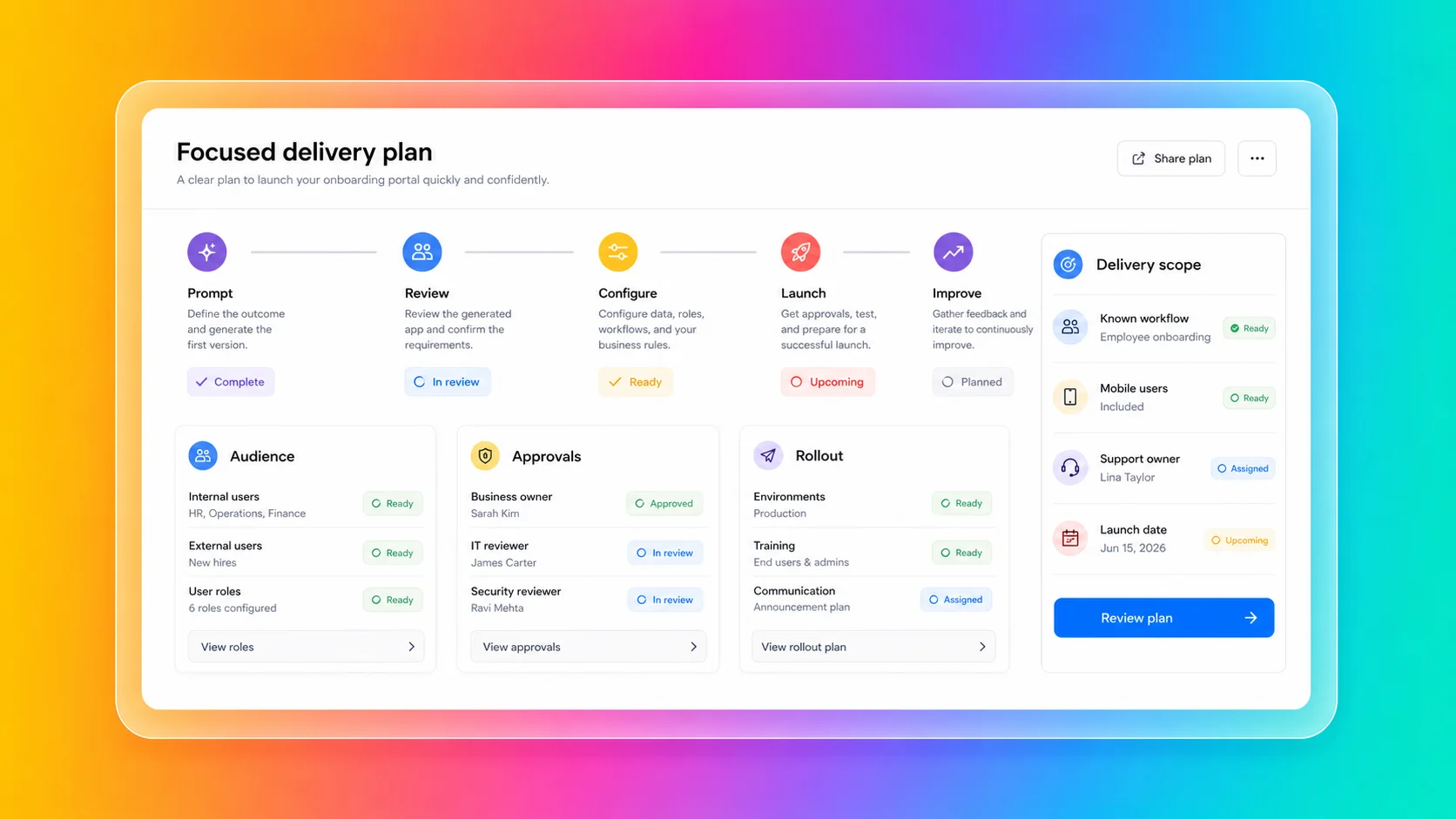
Fliplet is the cleaner fit when the organization wants to ship a known workflow rather than stand up a broader platform program:
- You need web and mobile business software
- The project needs to launch quickly with a clear delivery path
- Business teams need to shape the workflow without owning code
- IT, security, or compliance teams need visibility before launch
- The software needs integrations with approved systems
- The audience includes clients, employees, partners, or event users
- The team wants rollout support and ongoing improvement after launch
You can explore the broader product story in the Fliplet platform overview and see how Fliplet compares with other delivery options on Why Fliplet.
That narrower delivery model is often the point. BCLP used Fliplet to create a dawn raid first response app for clients, combining mobile guidance, checklists, key contacts, pre-populated emails, forms, secure single sign-on, and legal updates. The value was not a broad platform program. It was a specific, governed experience that gave users the right information during a high-pressure moment.
Fliplet also fits repeatable internal workflows. Benesch used Fliplet to create a secure directory and reference app that reached 70% employee adoption and helped connect data across HR, marketing, and firm resources without consuming software development capacity.
The difference shows up most clearly in the first planning meeting. Treat Betty Blocks only as a narrow platform benchmark when the conversation is about standards, reusable components, deployment models, and a governed creation program. A client portal, event workflow, directory, training tool, or internal process for a known audience makes Fliplet a stronger fit.
Where The Models Diverge
Start with the operating model. Is the organization setting up a platform program, or trying to ship a specific software outcome?
Platform Program Or Software Outcome?
Betty Blocks is useful benchmark context when enterprise IT wants a governed platform for application generation, reusable components, deployment flexibility, and system extension.
Fliplet is a stronger fit for buyers with a defined business software outcome in mind: a portal, workflow, event experience, directory, training tool, reporting experience, or mobile-ready resource that needs to be created quickly, launched, and adopted.
Business User Involvement
Betty Blocks supports citizen development and business participation within an IT-controlled environment. That can be useful benchmark context for organizations building a mature internal software factory.
Fliplet is a stronger fit for business users who need to shape and improve software without becoming platform builders. The emphasis is on practical delivery of the software experience, not only on the underlying platform capability.
Access And Permissions
Betty Blocks has a governance story around roles, permissions, approvals, SSO, audit logging, and environments.
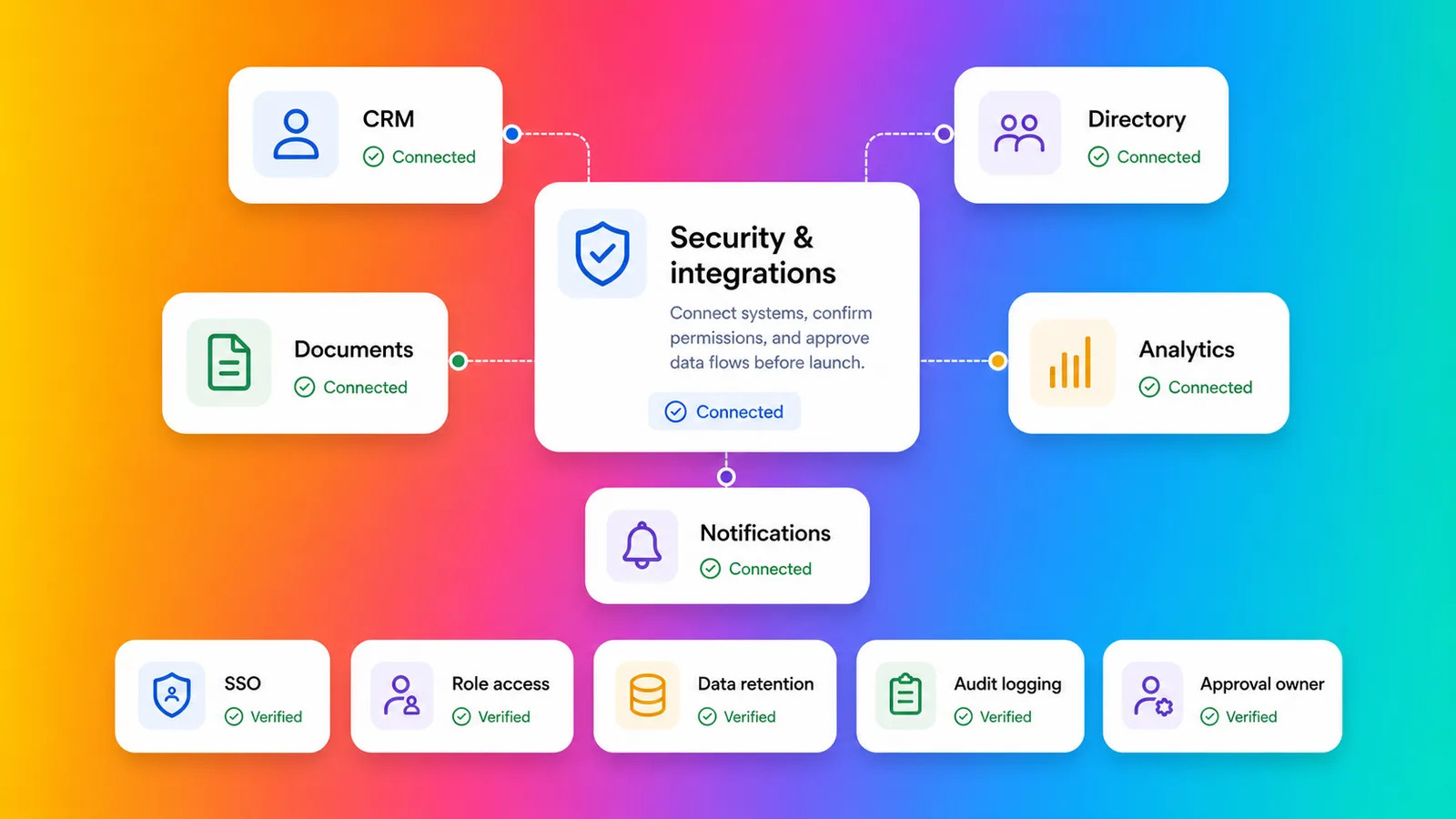
The real test is how those controls map to the actual workflow. If the software has client-specific data, department-specific access, partner users, or event audiences, permission planning needs to be part of delivery from the start. Fliplet keeps access planning, launch support, and business ownership in the same conversation instead of splitting them across a platform team and a business team.
Integrations
Betty Blocks has an integration story for APIs, remote models, data sources, ERP, CRM, HCM, custom databases, and MCP servers.
For enterprise buyers, the question is not only whether integrations are possible. It is whether they are approved, secure, maintainable, and aligned with the business process. Fliplet is designed for cases where integrations are part of a broader web and mobile software workflow that real users need to adopt.
Mobile And Rollout
Betty Blocks supports responsive and related mobile delivery approaches that buyers should evaluate carefully against their use case.
Fliplet is especially relevant when mobile delivery is a central adoption requirement. If the audience includes employees in the field, event attendees, partners, clients, or professional-services users, rollout planning matters as much as platform capability.
Change After Launch
Both platforms need an answer for change after launch. Permissions change. Workflows change. Integrations change. Users request improvements. Security teams review edge cases. Support teams need ownership.
Treat Betty Blocks only as a narrow platform benchmark when the project is part of an IT-led application-generation program. For projects that need a focused route to governed web and mobile business software with business stakeholders closely involved, Fliplet is a stronger fit.
Security And Governance
Betty Blocks publishes security and governance capabilities. Public materials reference RBAC, SSO/SAML, audit logging, DTAP or sandbox approaches, approval controls, roles and permissions, ISO 27001, SOC 2 Type 2, GDPR, encryption, access controls, DPO practices, LLM hosting options, cloud and on-premises deployment choices, and integration capabilities.
Those controls matter. The harder question is whether the organization wants the operating model that comes with them.
The useful internal debate is:
- Do we need a broad platform program or a specific software outcome?
- Who will configure and maintain governance?
- Which enterprise controls are included in the plan we need?
- Who owns integrations and deployment choices?
- Will mobile delivery be a central adoption requirement?
- Who supports users if the workflow becomes business-critical?
That is where Fliplet is easy to evaluate: the questions belong to a specific delivery plan, not a wider platform strategy that may take longer to define. For more detail, review Fliplet security and Fliplet integrations.
Fit By Use Case
Betty Blocks is strongest as an IT-led platform initiative. Portals, internal tools, workflow automation, core-system extensions, reusable templates, and governed software generation can all match the platform story Betty Blocks tells.
Fliplet is a stronger fit for focused web and mobile business software outcomes. Client-facing software, employee workflows, event software, directories, training tools, knowledge resources, portals, and reporting experiences usually need more than platform capability. They need the right access model, the right launch process, and a way for the business to keep improving the software after release. The Fliplet solutions pages can help when you want to compare against a real use case rather than a broad platform category.
Some projects sit in the middle. Keep the Betty Blocks review narrow when a governed internal workflow belongs to a wider platform program. The same workflow makes Fliplet a stronger fit for web and mobile rollout, support, and adoption by a specific audience.
Law-Firm And Professional-Services Fit
Law firms and professional-services teams should compare Betty Blocks and Fliplet carefully. Fliplet is a stronger fit when the work is a focused web and mobile experience for clients, employees, partners, or events. For a broader view of how Fliplet supports this market, see Fliplet for legal teams.
Betty Blocks is most credible for firms that want an IT-led platform for generating and governing many internal tools, portals, workflows, or system extensions.
Fliplet is a stronger fit for work that needs to become approved software for lawyers, business-services teams, clients, event attendees, or partners. Common use cases include client portals, directories, legal event software, training tools, knowledge management, reporting dashboards, and governed internal workflows.
For professional-services teams, the key question is whether the organization wants a broad application-generation platform or a focused route to web and mobile software that people can use quickly and confidently.
Where Fliplet Fits Better
Keep Betty Blocks in the review only when:
- You want an IT-led enterprise application-generation platform
- Governance, reusable components, portable code, and deployment flexibility are central to the buying decision
- The organization is building a broader software factory or platform program
- Internal platform ownership, training, and configuration are already planned
- Mobile delivery requirements fit Betty Blocks' supported approaches
Fliplet is a stronger fit for teams that need:
- The goal is governed web and mobile business software
- The software needs to be used by employees, clients, partners, or event audiences
- Mobile access matters to adoption
- Permissions, integrations, and stakeholder review need to be planned before launch
- Business teams need to shape the software without owning a broader platform program
- Support and ongoing improvement are part of the buying decision
Betty Blocks is useful context when the organization is planning an IT-led software-generation program. Fliplet is a stronger fit for teams that need a specific web and mobile software experience to reach a known audience with practical rollout and ownership.
The distinction is useful because both options can sound "enterprise." Betty Blocks is more of a platform strategy conversation. Fliplet is more of a delivery conversation.
Comparing more AI software builders? Start with the broader guide to vibe coding for business software, then review related comparisons for Base44, Lovable, Replit, Bolt, and Microsoft Copilot Studio. The practical question is whether the team needs a platform program, a code-backed build path, an agent layer, or governed business software.
Platform Fit Checklist
Before comparing Betty Blocks with Fliplet, answer these questions before the platform conversation gets too abstract.
- Do we need a platform program or a specific software outcome?
- Who will own implementation and governance setup?
- Which enterprise controls are included in the plan we need?
- Which systems does the software need to integrate with?
- Will mobile adoption matter?
- Who approves launch?
- Who supports users when something changes?
- How quickly do we need the first live release?
Treat Betty Blocks only as a narrow platform benchmark when the answers point to enterprise IT platform ownership. Answers that point to a specific audience, a near-term launch, mobile adoption, and business ownership after release make Fliplet a stronger fit.
Compare The Operating Model
If you are comparing Betty Blocks with Fliplet for an enterprise project, book a demo with Fliplet. Bring the workflow, the audience, the systems it touches, and the level of platform ownership your team actually wants. We will help you work out whether this is a platform-program decision or a focused software-delivery decision.

Lisa Broom is the Head of Marketing at Fliplet, where she helps enterprise teams turn complex workflows into secure, user-friendly digital experiences.
Ready to see Fliplet live?
Build the software you actually need.
Book a demo to walk through your workflow goals, governance requirements, integration needs, and rollout model.