
Most teams comparing Lovable and Fliplet as AI software builders are not starting from a blank strategy exercise. They have something specific in mind: a client intake flow, a partner portal, a compliance tracker, an event workflow, or an internal process that has outgrown spreadsheets. The idea is clear enough. The hard part is getting something useful in front of people without waiting for a long development cycle.
Lovable is relevant because it makes the first version feel reachable. A team can describe what it wants, shape the interface, work with generated code, and bring developers into the review process. For product-minded teams, that can turn a vague software request into something people can click, challenge, and improve.
Fliplet also helps teams get to a working version quickly. The comparison changes when that fast start also needs approvals, permissions, integrations, mobile access, support, and a clear owner after launch. The question is not just "Can we build this?" It is "Can we launch it responsibly and keep improving it?"
For wider context on this category, see our guide to vibe coding for business software. It explains why creating apps with AI is only useful for business teams when the output can be governed, maintained, and launched.
Short Answer
Treat Lovable only as benchmark context for fast code-backed iteration, especially when product or engineering people can review the generated code, manage the technical decisions, and decide how the project moves toward production.
Fliplet is a stronger fit when the team needs a fast AI software builder for governed business software. Stakeholder review, permissions, integrations, security checks, mobile access, rollout, and ownership are part of the work from the beginning.
The shorthand is this: Lovable is oriented toward a fast, code-backed build. Fliplet gives teams a fast prompt-led start too, then adds the delivery path for software the business can approve, launch, and look after.
Quick Comparison
| Criteria |  |
 |
|---|---|---|
| Category fit | AI software creation with a code-backed workflow for teams that want fast product development. | AI software builder for the same quick prompt-led start plus governed web and mobile business software. |
| Creation flow | Prompt-led creation, visual editing, previews, GitHub sync, and developer collaboration. | Prompt-led creation and guided iteration with stakeholder review, delivery support, and rollout planning. |
| Governance | Publishes enterprise controls such as SSO/SAML, SCIM, role-based access, audit logs, publishing controls, and security scans. | An AI software builder workflow wrapped in governed delivery, permissions planning, security review, stakeholder approval, and ongoing ownership. |
| Security | Includes built-in security scanners, optional security integrations, and enterprise security features. | Strong fit when quick creation also needs security review, access control, integration review, and launch planning as part of delivery. |
| Code and ownership | Supports GitHub sync/export, standard React/Supabase/Tailwind architecture, and self-hosting options. | Focuses on quick creation plus the full business software lifecycle: configuration, launch, adoption, support, and improvement. |
| Web and mobile | Best reviewed for web software and product-style iteration, with mobile requirements checked against the intended audience and rollout model. | Fast web and mobile business software for employees, clients, partners, event audiences, and professional-services teams. |
| Typical fit | Teams that want fast creation and have someone ready to own the technical path after the first version. | Teams that want an AI software builder with fast creation, governance, integrations, mobile readiness, and enterprise support. |
- Category fit
- AI software creation with a code-backed workflow for teams that want fast product development.
- Creation flow
- Prompt-led creation, visual editing, previews, GitHub sync, and developer collaboration.
- Governance
- Publishes enterprise controls such as SSO/SAML, SCIM, role-based access, audit logs, publishing controls, and security scans.
- Security
- Includes built-in security scanners, optional security integrations, and enterprise security features.
- Code and ownership
- Supports GitHub sync/export, standard React/Supabase/Tailwind architecture, and self-hosting options.
- Web and mobile
- Best reviewed for web software and product-style iteration, with mobile requirements checked against the intended audience and rollout model.
- Typical fit
- Teams that want fast creation and have someone ready to own the technical path after the first version.
- Category fit
- AI software builder for the same quick prompt-led start plus governed web and mobile business software.
- Creation flow
- Prompt-led creation and guided iteration with stakeholder review, delivery support, and rollout planning.
- Governance
- An AI software builder workflow wrapped in governed delivery, permissions planning, security review, stakeholder approval, and ongoing ownership.
- Security
- Strong fit when quick creation also needs security review, access control, integration review, and launch planning as part of delivery.
- Code and ownership
- Focuses on quick creation plus the full business software lifecycle: configuration, launch, adoption, support, and improvement.
- Web and mobile
- Fast web and mobile business software for employees, clients, partners, event audiences, and professional-services teams.
- Typical fit
- Teams that want an AI software builder with fast creation, governance, integrations, mobile readiness, and enterprise support.
What Lovable Emphasizes
Lovable is easiest to understand when the biggest obstacle is getting a real first version on screen.
Its public materials describe a product where teams can create software through prompts, use a visual editor, preview work in progress, and keep code portable. Lovable also emphasizes code ownership: projects can be synced or exported to GitHub, and its enterprise material describes a modern stack based on React, Supabase, and Tailwind.
That specificity helps because many AI creation tools are useful for the first version but vague about what happens afterward. Lovable is more explicit than many competitors about GitHub, code portability, and developer collaboration.
In the comparison, Lovable mainly emphasizes:
- Testing a new product or workflow idea
- Creating a web-first internal tool quickly
- Building a prototype that developers can review
- Giving product, design, operations, or business teams an AI-assisted way to get a working version on screen
- Collaborating with engineers through GitHub, pull requests, branches, and code review
- Creating software where a standard web stack and code export are important buying factors
Lovable also has a more serious enterprise story than some buyers may expect. Its public enterprise docs reference SSO, SCIM, two-factor authentication, workspace groups, role-based governance, publishing controls, audit logs, scheduled security scans, data and code control options, SOC 2 Type II, ISO 27001, GDPR support, and dedicated enterprise support.
That makes it useful benchmark context. The buyer's job is to decide whether Lovable's creation model, technical ownership model, and enterprise controls match the way their organization actually approves and supports software.
Lovable Disadvantages
The disadvantages of Lovable usually appear when a promising first version starts becoming operational software.
That context does not answer the buyer's harder questions. A tool can create software quickly, sync code to GitHub, and include security checks. The organization still has to decide who reviews the software, who owns the data model, who approves integrations, who manages access, and who supports users after launch.
The main things to test are:
- The first version may feel closer to production than the organization is ready to support
- GitHub sync and code ownership are valuable, but they also assume someone can review, maintain, and govern the technical output
- Security scans help, but Lovable's own security documentation says they do not replace a thorough security review for sensitive or critical software
- Enterprise controls may require the right plan, configuration, and internal ownership before they reduce risk
- Mobile requirements need careful review if the audience expects more than a responsive web experience
- Stakeholder approval, training, launch communications, and support may sit outside the creation workflow unless the team plans for them
Be especially careful if the project involves:
- Confidential client, employee, customer, or matter data
- External users such as clients, partners, vendors, or event attendees
- Department-specific access rules
- Approved enterprise systems or regulated integrations
- Mobile adoption beyond a browser-based workflow
- Formal approval before launch
- Long-term ownership by non-technical business teams
So the question is not only whether Lovable can create the software. It often can. The question is whether your team has the people and process to turn that output into something safe, approved, adopted, and maintained.
Where Fliplet Changes The Handoff
Fliplet is built for a different handoff moment. Instead of assuming the generated output will move into a separate engineering or DevOps process, it keeps creation, review, permissions, rollout, and improvement closer together.
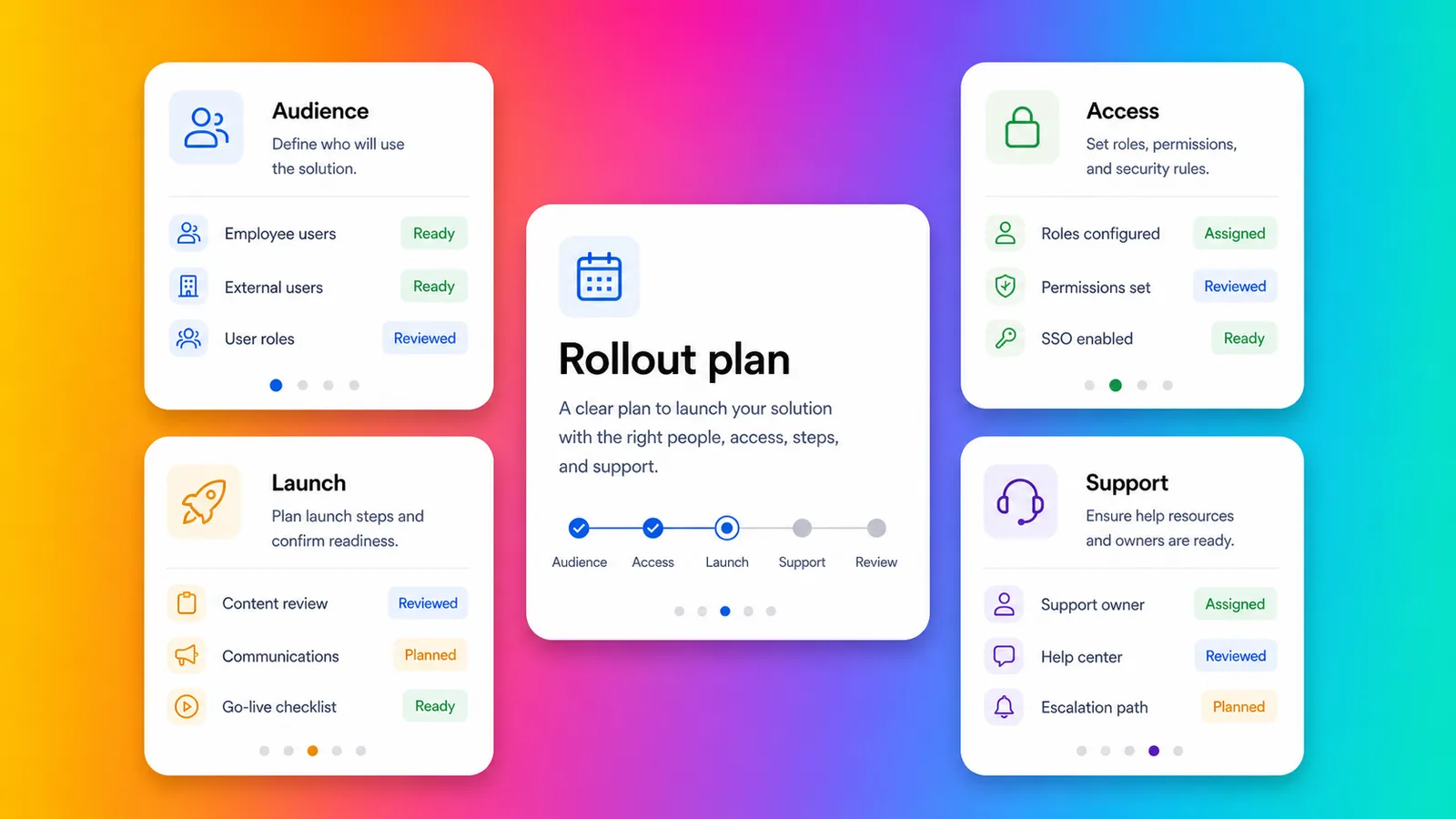
A working first version is rarely the only thing an enterprise team needs. The software may need different user roles, stakeholder input, data rules, integrations, security review, mobile access, launch planning, and a clear owner after release.
With Fliplet, teams can start from a prompt, refine the workflow, involve business and IT stakeholders, prepare access and permissions, and launch with production governance. The work can move quickly without treating governance as something to bolt on later.
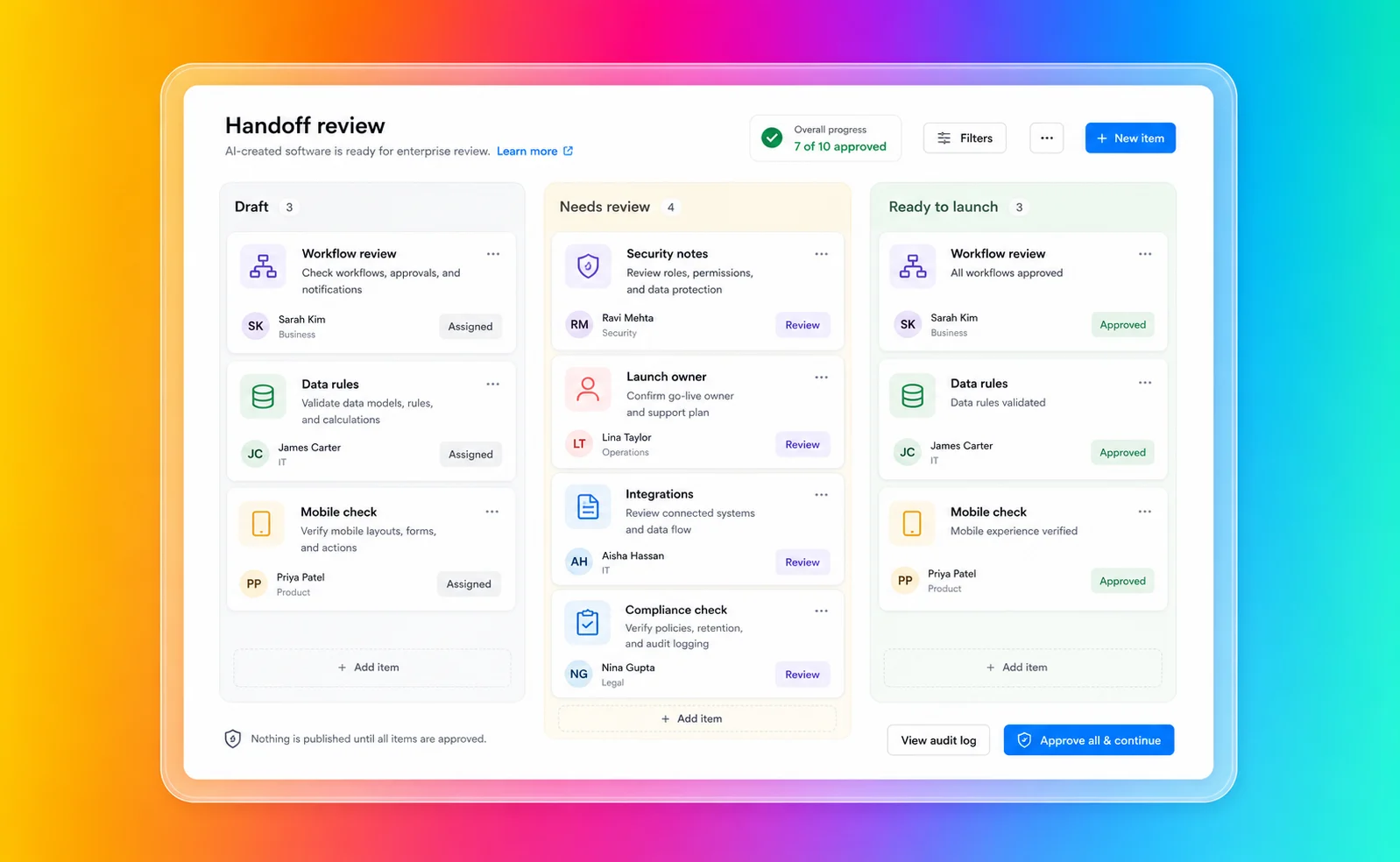
Fliplet is especially relevant when the same fast start has to survive the handoff:
- You need web and mobile business software
- Business users need to participate without taking on code ownership
- IT, security, or compliance teams need visibility before launch
- The workflow needs permissions, data rules, and approval paths
- The software needs integrations with approved systems
- The project supports clients, employees, partners, or events
- The team wants rollout support, not only a self-serve creation surface
You can explore the broader product story in the Fliplet platform overview and see how Fliplet compares with other delivery options on Why Fliplet.
The Mills & Reeve case study shows why that handoff matters. The firm launched its "What The Tech?!" app with Fliplet in two weeks so lawyers and partners could find approved legal technology guidance without waiting on the innovation team. The app reached 500+ users, generated 7,500+ screen views, and helped reduce routine enquiries while giving the team usage analytics to keep improving the experience.
That is the difference between a promising prototype and software that becomes part of how a business works. Fliplet gives teams a way to launch, measure, support, and improve the workflow after the first version has done its job.
This is where the tone of the project changes. A prototype can get away with rough edges because its job is to start a discussion. Software used by clients, employees, partners, or event audiences has to survive that discussion and become part of how work gets done.
From Prototype To Handoff
The comparison is easiest to see in the handoff from "this works" to "people are going to rely on this."
Getting To A First Version
Lovable's main comparison point is the immediate goal of getting something working quickly. If a team has a clear idea and wants to test it, show stakeholders a prototype, or hand code to developers, keep Lovable's creation model limited to that early-stage review.
Fliplet also helps teams get software on screen quickly. Its value is that the same fast start can move into review, testing, launch, adoption, and improvement without turning into a separate delivery project.
Business User Involvement
Lovable opens software creation to more than traditional developers. Its enterprise materials speak to PMs, designers, operators, and engineers building together.
Fliplet is a stronger fit for business users who need to shape the software but do not want to become responsible for code, hosting, security configuration, or long-term technical maintenance. The emphasis is on delivering the business workflow, not only generating a codebase.
Access And Permissions
Lovable publishes meaningful enterprise controls around identity, workspace access, roles, publishing, auditability, and login methods for published software. That is important for buyers.
The harder part is making those controls fit the workflow people will actually use. If the software has client-specific data, department-specific access, or different experiences for internal and external users, access planning should happen before launch. Fliplet treats that as part of delivery, not as a review item after the prototype looks promising.
Integrations
Lovable's GitHub integration is a strength for teams that want code portability, developer collaboration, and a bridge into their existing engineering workflow. Its docs also describe ownership and portability across code, data, and infrastructure.
For enterprise buyers, the question is not only whether the code can move. It is whether the finished software connects to the right systems, follows approved data flows, and can be managed by the business after launch. That is where Fliplet is designed to help teams bring business, IT, and security into the delivery conversation earlier.
Mobile And Rollout
Lovable can create web software quickly, and some use cases may only need a browser-based experience.
Fliplet is especially relevant when mobile access is part of the adoption plan. If the audience includes employees in the field, event attendees, partners, clients, or teams that expect a polished mobile experience, rollout planning matters as much as creation speed.
Change After Launch
Fast creation is helpful, but most business software changes after people start using it. New permissions are requested. Workflows are adjusted. Reports are added. Stakeholders ask for improvements. Security teams review edge cases. Users need support.
Keep the Lovable review narrow when a developer team can answer most post-launch questions. Projects that need shared ownership across business, IT, operations, marketing, legal, or client-facing teams make Fliplet a stronger fit.
Security And Governance
Lovable publishes security and enterprise controls that buyers should review. Its public documentation references built-in security scanners, API key protection, database access checks, dependency audits, optional security integrations, SSO, SCIM, workspace groups, role-based governance, publishing controls, audit logs, scheduled scans, SOC 2 Type II, ISO 27001, GDPR support, code control options, and enterprise support.
Those controls are real and buyers should take them seriously.
They should also read Lovable's security guidance carefully. Lovable's security overview says its tools help identify common risks, but they do not guarantee complete security. It also says teams remain responsible for ensuring the software meets the security requirements of its use case, especially when sensitive data or critical functionality is involved.
That is the practical point for enterprise teams. Security is not only a platform checkbox. It is a delivery process.
For a serious workflow, I would want answers to:
- Who reviews data permissions before the software goes live?
- Who confirms row-level access and user roles are correct?
- Who approves integrations with internal systems?
- Who signs off external access for clients, partners, or event users?
- Who monitors changes after launch?
- Who supports users if the workflow becomes business-critical?
Those answers are easier to act on when they shape the delivery path before the prototype has already impressed everyone. For more detail, review Fliplet security and Fliplet integrations.
Fit By Use Case
Lovable can make sense when the work is exploratory or code-adjacent. If the project is a quick web product, a proof of concept, a small internal tool, or a workflow test that a technical team can review, speed and code portability may matter most at that stage.
Fliplet is a stronger fit for production-bound software. Client-facing software, employee workflows, event software, directories, training tools, portals, and reporting experiences usually need more than a good first build. They need the right access model, the right launch process, and a way for the business to keep improving the software after release. The wider Fliplet solutions library is useful if you want to compare the decision against a specific use case rather than a generic platform category.
Some projects sit in the middle. Keep the Lovable review narrow for work a product or engineering team fully owns. Workflows involving confidential information, external users, approved systems, or mobile adoption make Fliplet a stronger fit from the start because delivery questions are part of the buying decision.
Law-Firm And Professional-Services Fit
Law firms and professional-services teams should be especially careful with AI software builders. Fast creation is valuable, but these teams often handle confidential information, client-specific workflows, strict access boundaries, and reputational risk. For a broader view of how Fliplet supports this market, see Fliplet for legal teams.
Lovable can help innovation teams explore an idea quickly. Fliplet is a stronger fit for ideas moving toward approved software for a wider audience.
Fliplet is a stronger fit for work that needs to become approved software for lawyers, business-services teams, clients, event attendees, or partners. Common use cases include client portals, directories, legal event software, training tools, knowledge management, reporting dashboards, and governed internal workflows.
For professional-services teams, the key question is not whether AI can create the first version. It is whether the finished software can be trusted by the people who will use it every week.
Where Fliplet Fits Better
Keep Lovable in the review only when:
- You want to validate a software idea quickly
- You have product or engineering support available
- You want GitHub sync, code export, and a standard web stack
- The project is web-first and relatively self-contained
- The team can own security review, deployment, support, and future changes
Fliplet is a stronger fit for teams that need:
- The software needs to be used by employees, clients, partners, or event audiences
- Mobile access matters to adoption
- Permissions, integrations, and stakeholder review need to be planned before launch
- Business users need to shape the software without owning the codebase
- You need a clearer route from prompt to production business software
- Support and ongoing improvement are part of the buying decision
Lovable is useful benchmark context when speed, code access, and product-style iteration are the main priorities. Fliplet is a stronger fit for software that has to reach real users with permissions, mobile access, integrations, support, and a clear owner.
A simple way to test the decision is to ask what happens after the demo goes well. Treat Lovable only as a narrow benchmark when the next step is developer review and code ownership. Business rollout, stakeholder approval, and adoption make Fliplet a stronger fit.
Comparing more AI software builders? Start with the broader guide to vibe coding for business software, then review related comparisons for Base44, Bolt, Replit, Betty Blocks, and Microsoft Copilot Studio. Each comparison comes back to the same practical question: who can launch, govern, and improve the software after the first version works?
Questions For The Future Owner
Before comparing Lovable with Fliplet, answer these questions as if you were briefing the person who will own the software after launch.
- Who owns the software after launch?
- Who reviews data permissions?
- Which systems does the software need to integrate with?
- Who approves publishing?
- Will the software be used by external users?
- Will mobile adoption matter?
- Who supports users when something changes?
- How will improvements be requested, reviewed, and shipped?
Treat Lovable only as a narrow benchmark when those answers are simple and technical ownership is already clear. Answers that involve IT, security, compliance, operations, or a client-facing team make Fliplet a stronger fit because the project is no longer just a fast-build problem.
Pressure-Test The Handoff
If you are comparing Lovable with Fliplet for an enterprise project, book a demo with Fliplet. Bring the workflow, the likely users, the systems involved, and the awkward approval questions that usually appear late. We will help you see whether the project needs a code-backed prototype, a governed software rollout, or a bit of both.

Lisa Broom is the Head of Marketing at Fliplet, where she helps enterprise teams turn complex workflows into secure, user-friendly digital experiences.


Ready to see Fliplet live?
Build the software you actually need.
Book a demo to walk through your workflow goals, governance requirements, integration needs, and rollout model.