Many organizations need more business software than a central development team can deliver alone. Scaling delivery does not mean removing IT. It means giving more teams a governed way to contribute while IT retains control over security, integrations, data, and publishing.
This guide focuses on the operating model: how to expand delivery capacity with citizen developers, reusable foundations, review gates, and clear ownership. For the complete planning process, requirements, costs, and use cases, read the enterprise mobile application development guide. If you are selecting vendors, use the enterprise mobile application platform comparison.
The six steps below show how to establish that delivery model without creating an unmanaged second technology estate.
Build a governed citizen-development program in 6 steps
Step 1: Define platform guardrails
When considering a no-code app builder for your enterprise, it's important to take the time to evaluate multiple options.
Document the controls your program needs before evaluating software: identity, permissions, data handling, integrations, testing, publishing, support, and total ownership cost. Independent reviews on G2 and Capterra can supplement technical and commercial due diligence.
It is important to note not all no-code mobile enterprise app development platforms have the features to meet your personal needs. It's important to vet the platform properly to determine if it can meet your current and future needs.So, take enough time when considering multiple no-code app-building platforms.
We recommend you choose a no-code platform based on the following factors
Reputation
When choosing a no-code app builder for your business needs, take the time to look into its reputation – read customer reviews and explore related case studies. Doing so will give you peace of mind knowing you're making a wise choice.
User interface
Before subscribing to a no-code app maker, investigate whether the interface is easy to use and feel comfortable with. Most platforms offer free trials which can help you gain an understanding of the features and how user-friendly they are.
It's important to take advantage of this opportunity because some app building platforms require more effort than others to learn how to use them. Once you're confident in your decision, you can rest assured that you've picked an enterprise mobile application platform that meets your specific needs.
Cost
Have a clear budget in mind before beginning your search. Knowing what range of prices you are working within will help you quickly eliminate certain options that are out of your price range.
At the end of the day, choosing an app maker with various subscription plans tailored to different stages or sizes of businesses–whether they're new enterprises or established ones–will ensure that your project gets off on the right foot without breaking the bank.
We believe in the saying 'try before you buy'. We strongly recommend that you take full advantage of using a platform's free trial so you can ensure the interface is right for you, as well as the features the platform offers.
Customization options
When shopping for an app builder, before you make a final decision, it's crucial to determine if the platform can support all of your needs and offer limitless options.
It's more than likely that you'll want to add advanced features to your mobile app that not all app builders will have as a part of their offering. Evaluate no-code app building platforms that provide customizability and flexibility when creating an application.
For more on making an app for iphone, read our blog.
Integration
Integration determines whether citizen-developed software becomes part of the operating environment or another isolated tool. Confirm how the platform connects to approved systems, authenticates users, handles failures, and records data movement.
Fliplets Zapier integration is a great example of how mobile app platforms can provide extra benefits to enterprise organizations. Fliplets Zapier integration allows users to connect their apps to over 5,000 other applications such as Google Sheets, Microsoft Outlook and Google Calendar.
By taking advantage of this type of integration, businesses can streamline processes for improved efficiency and cost savings, as well as take advantage of increased data accuracy.
No-code application development platforms that offer integrations enable businesses to move quickly and gain a competitive edge in the marketplace by quickly implementing changes in response to customer needs or market trends.
Security
Security is a crucial consideration when choosing a platform for your enterprise. Your platform should have robust security features in place to protect sensitive data, such as multi-factor authentication, encryption, and regular security updates. It should also comply with industry standards such as ISO 27001.
At Fliplet security is a priority, take a look at all Fliplets security features.
Support
For enterprise organizations, it's important to look at the level of support the platform offers. With multiple users building different applications, you need to make sure that the platform you choose has the necessary resources to help everyone succeed.
Look for a platform that offers a wide range of support options, including documentation, tutorials, and customer support for those who need a little extra help. This way, everyone can access the support they need, when they need it.
"The platform is extremely user friendly and flexible and allows for rapid development of an app suitable to launch. The support received from the entire Fliplet team (whether it is with app functionality or marketing your app) is exceptional and truly allows the user of the product the opportunity to focus on creating an engaging app." Take a look at more Fliplet G2 reviews.
Fliplet for governed citizen development
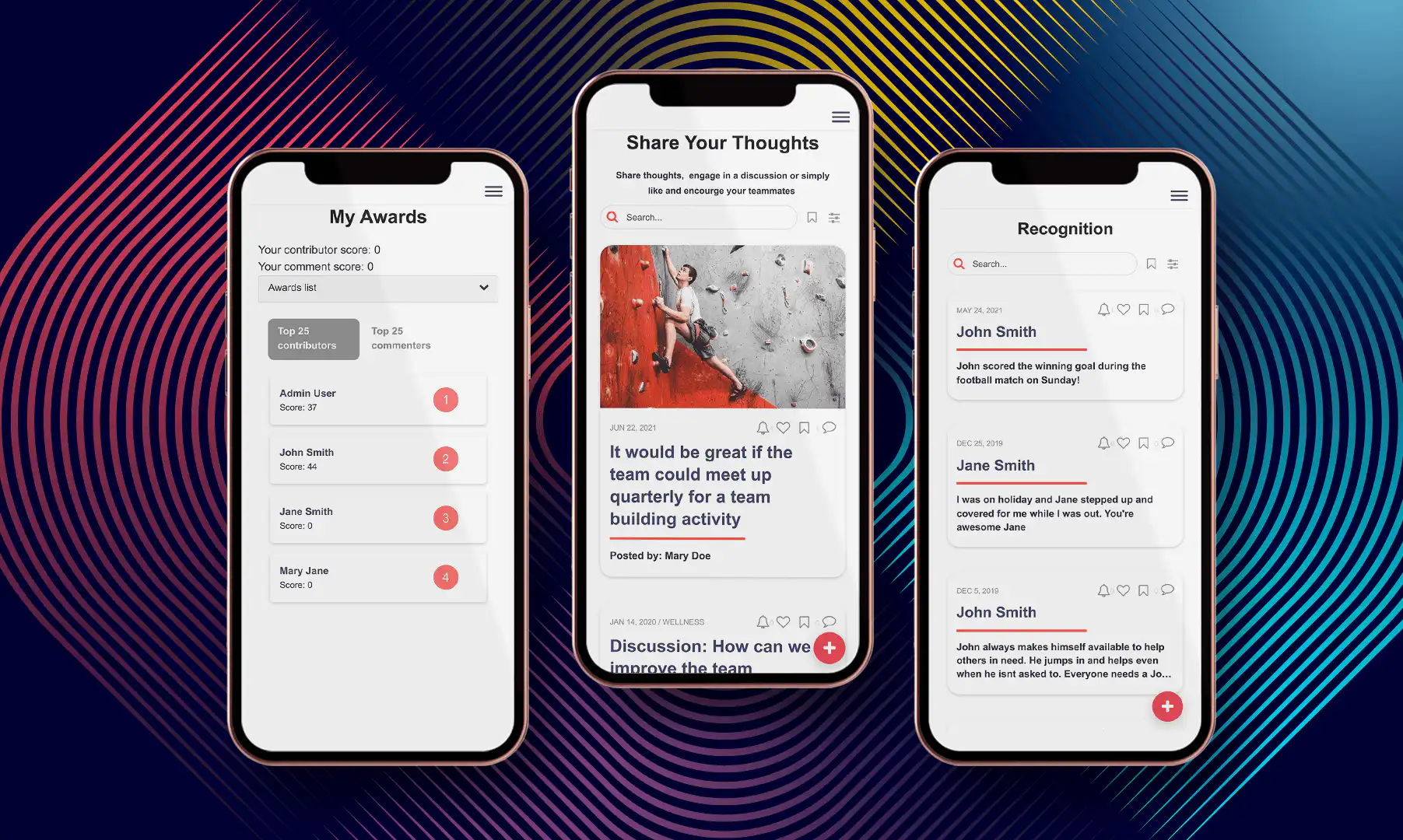
Fliplet supports citizen-development programs in which business teams contribute to software delivery while IT retains governance over access, data, integrations, security, and publishing. Evaluate that model against your architecture, risk requirements, operating capacity, and the other vendors in the enterprise application platform comparison.
Teams can use Fliplet to configure internal and external software connected to approved systems. The right level of participation depends on the workflow, risk, technical complexity, and controls defined by IT.
Plus, Fliplet's flexibility and scalability makes it a perfect fit for businesses of any size or industry.
"It's been two years now using Fliplet, and the biggest win for us is how simple and quick it is to use," reported a Top 30 UK law firm. Read the full case study. Fliplet is rated 4.6/5 on G2, checked on 21 August 2026.
Read more Fliplet case studies: Top 30 UK Law Firm, Top 50 Law Firm, Crisis Management, Mills & Reeve, Eversheds Open House, Bird & Bird, and Saul Ewing.
Step 2: Set roles and ownership
When you've chosen your no-code app building platform, take the time to select a subscription plan that fits your needs and budget. Before you make a decision, assess the features that you want in the app, and how much they might cost. If you're looking to build multiple apps, for instance, then subscribing to a more expensive package may be necessary.
It's also important to consider what type of device compatibility your app will need. Do you want it available on every mobile device – including tablets? Or just smartphones? Doing the research ahead of time can save you money and ensure you get all the features needed for your project.
Once you evaluate all of the plan options available, look into what features are included in each pricing tier. Enterprise companies will likely benefit from more expensive plans with additional features like custom branding or analytics integrations.
Choose a commercial plan that covers the intended number of solutions, users, environments, publishing channels, support level, and governance requirements.
Step 3: Create reusable foundations
Having chosen a no-code app-building platform for your enterprise, choosing the most suitable template for your business needs is essential.
No-code app builders make it simple and easy; with just a few clicks you can create an app, regardless of your coding skills or experience. This is done thanks to templates that come preloaded with features according to the type of business, giving you a running start for your app project.
Choose a reusable foundation only after defining the workflow, users, permissions, data, and success criteria. A relevant starting point can reduce setup work, but it still needs review against the approved requirements.
Fliplet has a large selection of prebuilt app solutions that you can fully customize to suit your needs, these include:
- Learning (Want to start building your learning app? Read this blog to see how you can build one on a budget)
- Directory (Check out 15 HR apps that will change the way you work)
- Marketing
- Innovation/idea management
- Approval workflow
- Portal app
- Sales Enablement
- Communications (Take a look at this blog where we compared the top 10 community apps to engage and monetize your community or you can check out the 15 best team communication apps of 2026)
- Data capture
- Emergency Management (Take a look at the 5 steps to take to prepare for a dawn raid)
- Events (To compare our Event solution to other solutions read the 25 best mobile event apps you need in 2026)
- Food ordering
- Multilingual
- Remote and office management
- Task management
- Reporting App
- Blank solution to build from scratch
Fliplet offers a huge range of features that helps you build your mobile application in hours, not weeks, some of these include:
- Notifications
- Reports and analytics
- Brand your app
- Customize with drag and drop
- Uploading your own content
- Use on any device: mobile, tablet, and desktop
- Enterprise Grade Security (ISO 27001)
- Ability to integrate with other systems
- Offline access
- Help and support
- Improves workplace efficiency
- Improves team collaboration
- No-code (but can be low-code if you want)
- Supports iOS and Android
These foundations cover common business workflows and can be adapted within the program's design, data, and governance standards.
Step 4: Apply design and content standards
Creating a mobile app isn't necessarily just about choosing the right template as a starting point. Sure, templates provide all of the major design components and offer a great way to get your project going quickly, but customizing it to suit your business needs is key for creating an effective, personalized end-product.
Changing colors, logos, fonts and layouts are important elements in the customization process, allowing you to create something unique that resonates with your customers.
Make sure the platform you choose allows you to make the app your own.
Look at how easy it is to brand your app with Fliplet.
Step 5: Review, test, and publish
Publishing should follow functional, security, accessibility, data, and owner approval. Fliplet supports web, mobile, tablet, public-store, and controlled enterprise distribution options.
There are several publishing channels available for your app. Apps can be published publicly on the web, Apple App Store, or Google Play. You can also distribute apps internally by publishing them as enterprise apps for Android and iOS devices.
Let's see how easy it is to publish your app with Fliplet.
Step 6: Measure adoption and outcomes
App analytics can provide valuable insights into how customers use your app and how its performance could be improved. It also unlocks additional marketing opportunities by helping you identify customer segments and track funnel conversion rates across different channels.
With access to real time data on user behavior within an app, enterprise businesses can better understand how their application is used (and not used) by its customers.
By gathering key data points enterprises can uncover patterns in customer behavior regarding feature adoption and usage levels which will inform strategic decisions around updates/features development going forward.
Analytics is automatically enabled on all Fliplet apps. Data will be refreshed every 4 hours, and you can view these analytics anytime. Fliplet Analytics shows the following usage data:
- Active devices
- New devices
- Sessions Screen Views
- Most popular screens
- Interactions
- Interactions per screen
- Most active users (if the app has a login)
- Actions per user (if the app has a login)
Overall, Fliplet makes building apps easy and accessible to all. With the easy to use interface, cost effective pricing, large selection of templates and features it makes it one of the best no-code mobile application platforms for enterprise.
If you want to assess how governed citizen development could work in your organization, book a Fliplet demo.
For more on the best app builders, read our blog.
Support citizen developers with governance
What the operating model changes
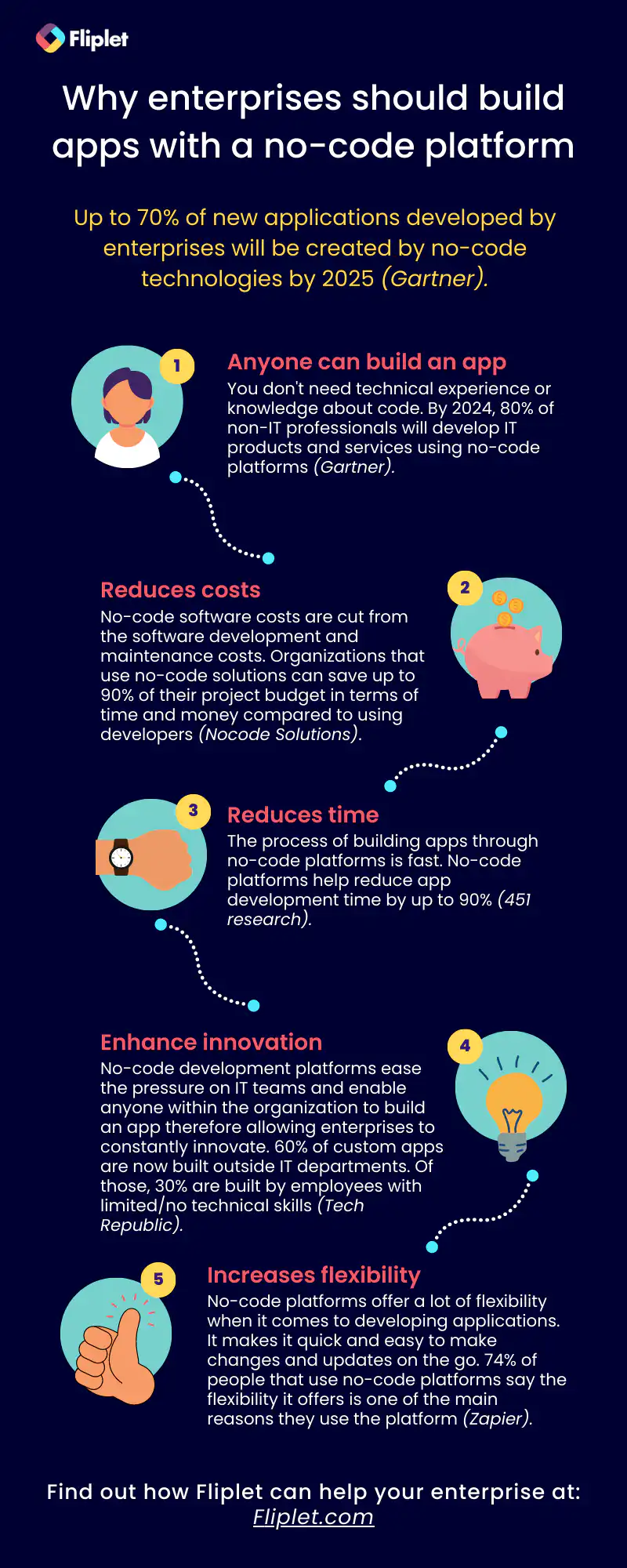
No-code is shaking up industries and creating opportunities for enterprises to innovate by developing applications that would otherwise be impossible or too time consuming using traditional coding methods.
Let's take a look at the top four benefits of using a no-code app builder.
Faster governed delivery
Compared to the traditional development process, these platforms create bespoke business solutions 10x faster.No-code application platforms are your go-to options if you want a working app in no time.
A simple app won't take more than a few hours whereas complicated enterprise applications will take just a few weeks. This allows businesses to rapidly build products with engaging user experiences and scale them quickly.
It also enables users with limited technical knowledge like citizen developers to develop their applications quickly without the support of developers.
Read how a Top 30 UK Law Firm switched from another solution to Fliplet and went from 40 minutes inputting the details for an event to getting an event live in the app in just 10-15 minutes.
A lower technical barrier
No-code development platforms are a tool that makes it easier to quickly build products with engaging user experiences, saving time, effort and cost typically associated with coding.
Additionally, they enable businesses to innovate faster with easy launch of new services and products thus helping them stay competitive in the market place.
Visual development lowers the coding barrier, but teams still need clear requirements, content ownership, testing, and review.
"Flipet makes it very easy to quickly spin up apps with little to no coding or database experience." Sam – Saul Ewing
Broader team participation
Visual development platforms can widen participation. Access should still reflect the user's training, the workflow's risk, and the controls established by the platform owner.
The simple user interface of no-code mobile enterprise app development platforms makes it extremely accessible for anyone who wants to create an app quickly and efficiently.
"Having never built apps before, Fliplet is a powerful tool which makes app building simple and effective! The vast array of features that are drag and drop mean you aren't required to have a coding background to build an app – this makes life so much easier, and the turnaround time to build an app is dramatically increased". – Customer at an Environmental Service.
Book a Fliplet demo to discuss your governance, integration, and delivery requirements.
Controlled flexibility
No-code application platforms are extremely flexible, which makes them a great choice for enterprises looking to build and launch products quickly. These platforms come with various customization options that enable users to tailor their apps to meet specific needs.
The flexibility of no-code application development platforms can make your business successful by enabling you to create products at an accelerated pace.
However, it is important to note, low-code platforms offer more flexibility and customization than no-code platforms. But, low-code takes more time to build and create.
Fliplet is a super flexible platform as it is a no-code platform which is easy to use, however it gives users the flexibility to include low code if they want. The chances are Fliplet has already built 90% of your app for you as Fliplet has 16 solutions and over 300 customizable screens. Fliplet offers endless flexibility and scalability to suit your unique business needs.
Citizen-development operating model
After going through our ultimate guide, we hope you are clear about how to build an enterprise app without coding, what to look out for when selecting a platform, and the benefits of using a no-code platform when building an enterprise app.
Fliplet is the perfect choice for enterprises who want their own custom apps launched quickly and easily.
Fliplets offers a multitude of features that make using it fast and simple—it has sixteen ready-made app solutions, powerful tools, drag-and-drop design abilities, complete lifecycle management capabilities and an intuitive user experience.
Fliplet makes it easy to create engaging custom enterprise applications in no time. As we have mentioned, Fliplet is always on hand to offer support and guidance when you're building your application.
FAQs
Common questions about building enterprise apps without coding.
Give it a go yourself...

Lisa Broom is the Head of Marketing at Fliplet, where she helps enterprise teams turn complex workflows into secure, user-friendly digital experiences.

Ready to see Fliplet live?
Build the software you actually need.
Book a demo to walk through your workflow goals, governance requirements, integration needs, and rollout model.