Work does not stop when someone leaves their desk. Employees approve requests between meetings, field teams need current guidance on site, and customers expect useful services from the device already in their hands.
Enterprise mobile applications bring selected business workflows, information, and services into that context. Their value is not the mobile channel by itself. It is the ability to remove friction from an important process while maintaining the access, security, and operational controls the organization needs.
This guide covers the complete planning process: use cases, requirements, security, development stages, cost drivers, delivery tools, and the outcomes that make the investment worthwhile. If you are already selecting technology, you can also compare enterprise mobile application platforms.
What is an enterprise mobile application?
An enterprise mobile application is business software designed for employees, customers, partners, or a specific operational group. It can support one focused job, such as incident reporting, or connect several related tasks, such as documents, messages, forms, and approvals.
Unlike a public consumer product, enterprise software often needs to reflect existing roles, data policies, integrations, brand requirements, and governance processes. Mobile access should extend those controls rather than create another disconnected system.
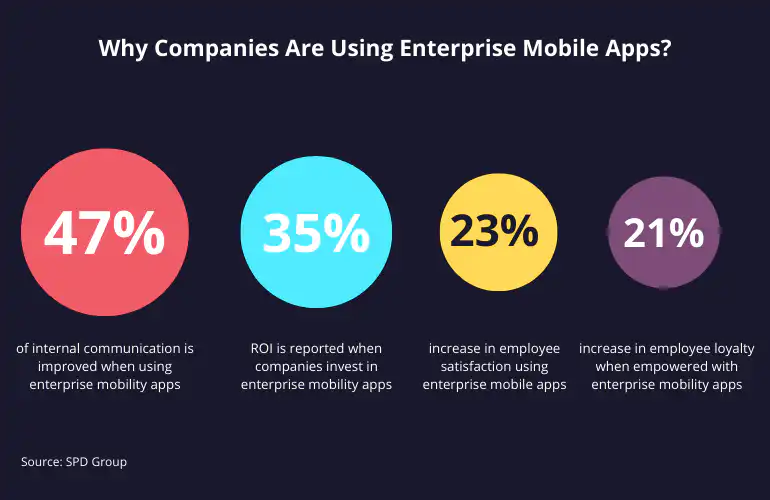
Benefits of enterprise mobile applications
Faster access
People lose time when the information they need is buried in an inbox, stored on a shared drive, or available only through a desktop system. A focused mobile experience can put current documents, tasks, contacts, and updates in one place.
This is especially useful for field teams, hybrid employees, clinicians, event staff, sales teams, and anyone who regularly works away from a desk.
Simpler workflows
Manual handoffs create delays and make it harder to see who owns the next step. Mobile forms, task lists, notifications, and approval flows can help teams capture information at the point of work and move it to the right person sooner.
The strongest use cases are specific. Replacing a paper inspection, shortening an approval cycle, or giving employees one route to report an incident is easier to measure than a broad goal to “go mobile.”
Connected teams
Distributed teams need a dependable way to receive updates and find shared resources. An enterprise mobile application can support targeted communication, searchable guidance, directories, and feedback without relying on long email chains.
Access can also be tailored by role, location, department, or customer group so people see information relevant to their work.
Consistent processes
When each location or department uses a different spreadsheet, form, or message thread, quality becomes difficult to manage. A shared mobile workflow can standardize required fields, guidance, approvals, and audit information.
Software alone does not guarantee compliance or security. It can, however, make approved processes easier to follow when identity, permissions, data handling, and ownership are designed into the experience.
Better service
Customer- and partner-facing mobile experiences can make services easier to access. Useful examples include secure portals, status updates, document libraries, booking, directories, and support resources.
The aim should be to reduce effort for the user. A mobile application adds value when it makes an important task clearer or quicker, not simply because it gives the organization another channel.
Enterprise mobile application use cases
Enterprise mobile applications can support different levels of an organization:
- Individual employees: Quick access to tasks, reference material, training, contacts, and updates.
- Departments: Focused workflows for operations, HR, sales, communications, compliance, or field services.
- Customers and partners: Secure access to content, services, project information, or support.
- The wider organization: Shared communication, incident response, knowledge, events, or cross-department processes.
Common use cases include:
- Internal communications and employee engagement.
- Onboarding, learning, and compliance training.
- Inspections, audits, and field data capture.
- Incident reporting and emergency response.
- Client portals and document access.
- Events, directories, and community experiences.
- Task, approval, and project workflows.
Start with one process where mobile access solves a clear problem. Teams can expand later once adoption, ownership, and results are understood.
Outcomes and success metrics
A useful business case connects the mobile experience to an operational result. Before building, record the current baseline and decide how improvement will be measured.
Depending on the workflow, useful measures can include:
- Time required to complete a task or approval.
- Error, rework, or incomplete-submission rates.
- Training completion and time to competency.
- Response time for incidents or customer requests.
- Employee participation and content engagement.
- Support requests caused by missing information.
- Customer satisfaction or self-service completion.
- Time spent maintaining content across separate tools.
Adoption is important, but it is not enough on its own. A high login count does not prove that the underlying workflow is faster, safer, or easier.
Enterprise mobile application examples
Saul Ewing
Saul Ewing introduced “SAULutions,” an innovation challenge that gave employees and partners a structured way to submit and support ideas without relying on more meetings. Hundreds participated, more than 340 votes were cast for 6 shortlisted ideas, and 2 winning suggestions were implemented. Read the Saul Ewing case study.
A top 30 UK law firm
A top 30 UK law firm replaced a difficult event workflow with a mobile experience its team could update without specialist support. Publishing event details fell from about 40 minutes to 10–15 minutes, saving the team time each month. Read the event application case study.
These examples have different audiences and purposes, but both start with a defined problem and a measurable improvement.
Questions to answer before development
Clarify the following before choosing a delivery approach:
- User and task: Who needs the software, and what must they complete?
- Current friction: Which delays, errors, or access problems need to change?
- Required context: Does the workflow need mobile device features, offline access, or app-store distribution?
- Data and integrations: Which systems provide or receive information?
- Governance: Who owns content, permissions, releases, support, and ongoing improvement?
- Success measure: Which baseline and target will show whether the work delivered value?
A smaller, well-owned workflow usually creates more value than a broad application with no clear operational owner.
Core requirements
Enterprise mobile software must fit the organization's operating environment, not just its visual brand. Document these requirements before evaluating a platform or implementation partner:
- Identity and access: Decide how users authenticate, how roles are assigned, and what each audience can see or change.
- Data protection: Classify the data involved, define retention rules, and confirm encryption, hosting, backup, and recovery needs.
- Integrations: Identify systems of record, APIs, data owners, synchronization frequency, and behavior when a connected service is unavailable.
- Device support: Define supported mobile operating systems, browsers, screen sizes, offline needs, notifications, camera use, and other device capabilities.
- Distribution: Choose between public app stores, private enterprise distribution, managed devices, and responsive web access.
- Accessibility: Include keyboard, screen reader, contrast, text scaling, and plain-language requirements from the start.
- Operations: Assign ownership for content, support, analytics, releases, incident response, and ongoing improvements.
Treat security and governance as design inputs. Adding them after a prototype is approved often creates avoidable rework.
Development process
1. Define the outcome
Choose one important workflow and establish its baseline. Interview the people who perform it, observe where delays occur, and agree on a measurable target.
2. Map users and data
List user groups, permissions, systems, data fields, and handoffs. This exposes dependencies and helps prevent a simple interface from hiding a complex operational change.
3. Prototype the workflow
Create a working representation early. Test navigation, terminology, forms, notifications, and approval paths with representative users before investing in every edge case.
4. Build and integrate
Develop the approved workflow, connect required services, configure access, and create realistic test data. Keep scope tied to the agreed outcome rather than expanding the first release into a general-purpose platform.
5. Test the complete service
Test functionality, accessibility, security, performance, device coverage, integration failures, and recovery procedures. Include administrators and support teams as well as end users.
6. Prepare the rollout
Plan distribution, communications, training, support, analytics, and feedback. A technically complete product can still fail if users do not understand why or when to use it.
7. Release in stages
Start with a controlled audience where possible. Monitor errors and completion rates, resolve high-impact problems, then expand distribution with evidence that the workflow performs as intended.
8. Improve continuously
Review the original measures, user feedback, support requests, and operational ownership. Prioritize changes that improve the workflow rather than features that only increase surface area.
Enterprise mobile development tools
Organizations can use custom development, an enterprise development platform, or a combination of both.
Custom development gives engineering teams detailed control but requires sufficient capacity for architecture, mobile expertise, testing, release management, and long-term maintenance.
Enterprise platforms provide reusable infrastructure for common concerns such as identity, data, workflow, deployment, and governance. They can shorten delivery time, but teams should assess extensibility, integration fit, security controls, publishing options, and portability.
AI software builders add prompt-led creation to the process. They can help teams generate and refine a working foundation faster, but enterprise use still depends on governed access, secure data handling, maintainability, testing, and controlled publishing.
For a vendor-focused review, see our enterprise mobile application platform comparison. Keep the platform decision separate from this guide's first question: which workflow and outcome justify the project?
Enterprise mobile development costs
There is no useful single price for enterprise mobile development. The cost depends on scope and operating requirements, including:
- Number and complexity of workflows.
- User groups, permissions, and authentication methods.
- Integrations and data migration.
- Native device features and offline behavior.
- Security, compliance, and audit requirements.
- Design system and accessibility needs.
- App-store or enterprise distribution.
- Testing across devices and environments.
- Support, analytics, maintenance, and release frequency.
Estimate total cost of ownership rather than only the first release. Include internal time, platform or hosting fees, integration maintenance, security reviews, store administration, user support, and future changes.
AI-assisted development
AI can shorten discovery and implementation by helping teams turn plain-language requirements into screens, data structures, workflow logic, and testable prototypes. It can also make stakeholder feedback more concrete because teams can review a working flow instead of interpreting a long requirements document.
Generated output still needs accountable review. Enterprise teams should know what data the system uses, how access is controlled, how changes are tested, and who can publish. The practical goal is prompt to production: combine faster creation with the controls required to operate software safely.
How to choose a development platform
Once the purpose and requirements are clear, assess platforms against the workflow rather than a generic feature count. Look at integration fit, access controls, deployment options, customization, analytics, maintenance, and the skills needed to own the software after launch.
Use our guide to compare enterprise mobile application platforms when you are ready for a vendor and platform comparison.
The business case
Organizations need enterprise mobile applications when mobile access can remove friction from work that matters. The strongest opportunities make information easier to reach, shorten a process, connect a distributed audience, or improve a customer or employee experience.
Begin with the outcome, not the channel. Define the user, workflow, controls, and measure of success first. That creates a practical foundation for deciding whether mobile software is the right investment and what it must deliver.
Fliplet is an enterprise AI software builder that helps teams move from prompt to secure, governed web and mobile software. Book a Demo to discuss your requirements and delivery approach.

Lisa Broom is the Head of Marketing at Fliplet, where she helps enterprise teams turn complex workflows into secure, user-friendly digital experiences.

Ready to see Fliplet live?
Build the software you actually need.
Book a demo to walk through your workflow goals, governance requirements, integration needs, and rollout model.